


This is a comprehensive Derp.Trade review covering what Derp.trade actually offers as a perpetual trading protocol on Solana. The platform lets traders open leveraged long and short positions on any on-chain Solana asset — even illiquid tokens — using an AMM-based design instead of an order book. .
What is Derp.Trade?
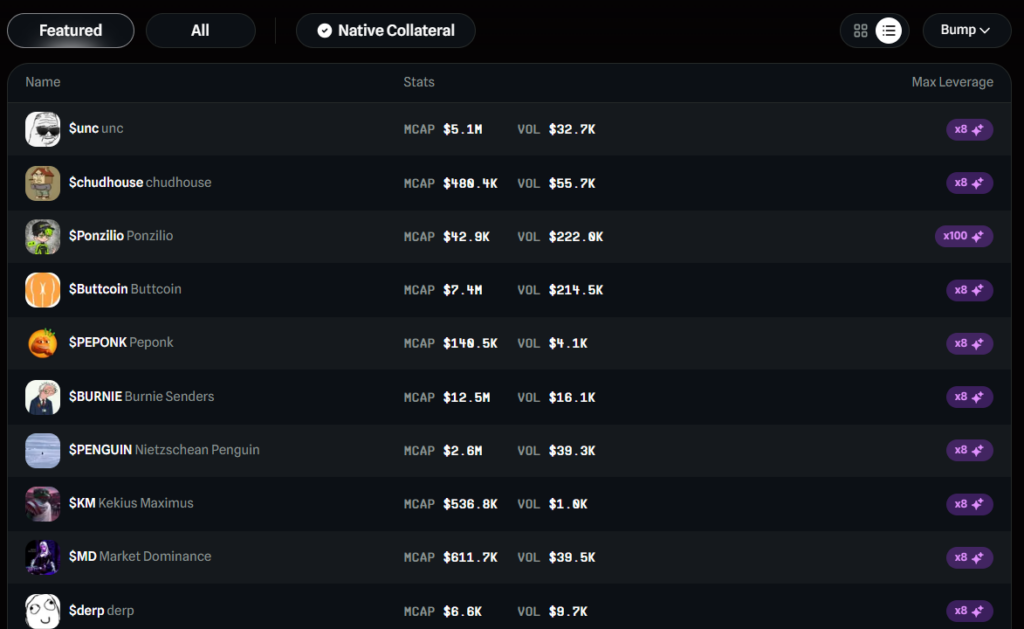
Derp.trade is the first perpetual trading protocol designed for any on-chain asset, enabling leveraged long and short positions without requiring high volume or liquidity. It is a derivatives exchange built on Solana where anyone can create and trade leverage markets instantly. Unlike traditional perpetual exchanges that rely on order books and need deep liquidity from many buyers and sellers, derp.trade uses an automated market maker (AMM) — a smart contract that is always ready to take the other side of any trade.
The product introduces a new derivative type called a DERP, which stands for Decentralized Perpetual. A DERP works similarly to a traditional perpetual future in that it lets traders take a leveraged position on an asset’s price, but the underlying mechanics are different. Because the AMM replaces the order book entirely, DERPs can support markets for virtually any token on Solana, including tokens with very low trading volume that would never be listed on centralized exchanges. All positions are denominated in USDT — traders deposit USDT as collateral, trade in USDT, and receive their profits in USDT.
Derp Trade Review: Core Features
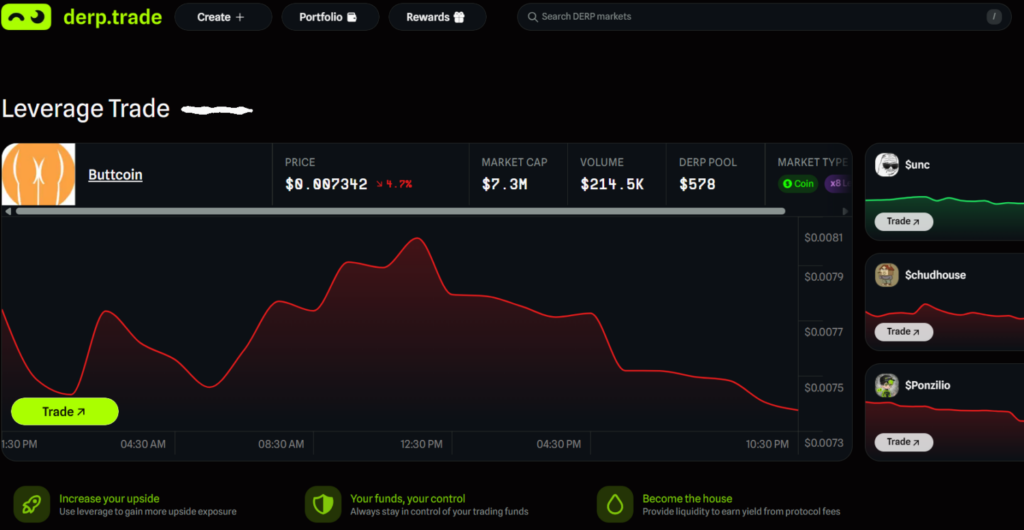
• Trade any Solana token: Derp.trade enables leveraged markets for virtually any token on Solana, including illiquid tokens that other platforms cannot support due to liquidity constraints.

• AMM-based execution: The automated market maker is always available to take the other side of trades, so users never wait for a counterparty and trades execute instantly without minimum liquidity requirements.
• Permissionless and free market creation: Anyone can list a new token market in seconds with zero fees, which is a significant departure from traditional exchanges that require approvals and deep liquidity to onboard new assets.
• Long and short leveraged positions: Traders can go long if they expect the price to go up or short if they expect it to go down, using leverage to amplify both gains and losses on the underlying token’s price movement.
• USDT-denominated positions: All collateral, trading, and settlement happens in USDT, which simplifies accounting and protects traders from volatility in the collateral token itself.
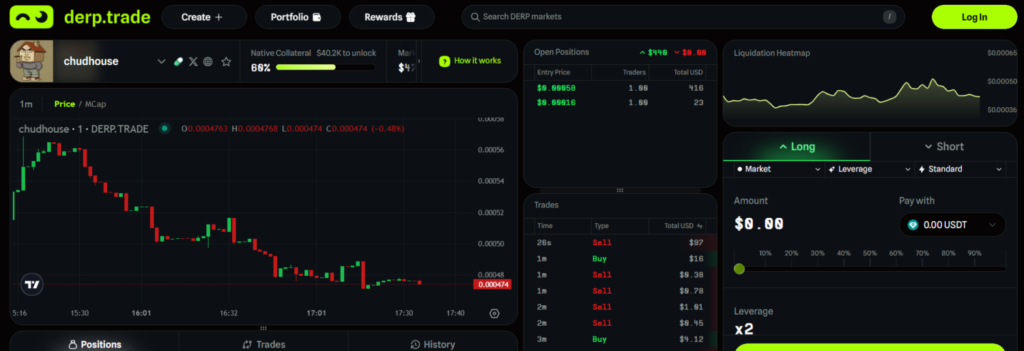
• Continuous funding rates: Funding is charged every 15 seconds in small amounts to keep markets balanced. If more traders are long than short, longs pay shorts a small fee, and vice versa.
• Real-time PnL and liquidation pricing: Unrealized profit or loss updates in real time as the underlying token price moves, and the trading interface clearly displays the liquidation price before any position is opened.
• Solana-native speed: The protocol is built on Solana for sub-second settlement and minimal gas costs of typically less than $0.01 per transaction.
• Isolated margin model: Derp.trade uses an isolated-only margin model, where each position has its own collateral allocation rather than sharing margin across positions like in cross-margin systems.
Derp.Trade Review: What are the Derp.Trade Fees?
In this Derp.trade Review, fee structure is transparent and on-protocol with no hidden costs. The table below summarizes every fee a trader pays when using the platform.
| Fee Type | Amount | Details |
| Trading fee (per side) | 0.7% of notional | Charged on both opening and closing, totaling 1.4% for a full round trip. Capped at 30% of collateral when opening or 30% of position equity when closing. |
| Trading fee — split | 0.3% / 0.1% / 0.3% | 0.3% goes to the AMM’s liquidity pool, 0.1% goes to the market creator, and 0.3% is the platform fee. |
| Funding rate | Variable | Charged every 15 seconds in small amounts. Longs pay shorts (or vice versa) depending on which side of the market is more crowded. Visible on the market page before opening a position. |
| Liquidation distribution | 50% / 30% / 10% / 10% | Not a fee, but the remaining equity in a liquidated position is split: 50% to the AMM pool, 30% to the platform, 10% to the market creator, and 10% returned to the trader as liquidation cashback. |
| Solana gas fees | < $0.01 per transaction | Standard Solana network fees apply to every transaction (opening, closing, depositing, withdrawing). |
| Market creation fee | $0 | Creating a new market on Derp.trade is permissionless and free. |
| Deposit / Withdrawal fee | $0 | The protocol does not charge for moving funds in or out, beyond the standard Solana gas already mentioned above. |
As a worked example from the documentation, opening a position with 10 USDT collateral at 10x leverage creates a notional position size of 100 USDT. The opening fee is 0.7% × 100 = 0.70 USDT, and closing the same position costs another 0.70 USDT, bringing total fees to 1.40 USDT for the round trip. Heavily skewed markets can produce significant funding charges over time, so the docs recommend checking the current funding rate on the market page before opening any long-term position.
How to Get Started With Derp.Trade
Now in this Derp.Trade Review, onboarding to Derp.trade is a four-step process that mirrors any other Solana DeFi application. The protocol does not require account creation, KYC, or custodial sign-up — connecting a Solana wallet is sufficient to start trading.
Step 1: Install a Solana wallet
Derp.trade is compatible with Solana wallets including Phantom, Solflare, and Backpack. The docs recommend Phantom as the most popular Solana wallet, available as a browser extension and mobile app. Users install the wallet, create a new account, save the recovery phrase securely, and set a password.
Step 2: Fund the wallet with SOL
A small amount of SOL is required to pay Solana transaction fees, which cost less than $0.01 per transaction. SOL can be purchased on a centralized exchange like Coinbase, Binance, or Kraken and withdrawn to the Solana wallet, or bridged from another chain using a service like Wormhole.
Step 3: Get USDT on Solana
All Derp.trade positions are denominated in USDT, so the wallet needs SPL USDT (the Solana version of USDT). USDT can be purchased on a centralized exchange and withdrawn to the Solana wallet, or swapped from SOL using a Solana DEX like Jupiter or Raydium.
Step 4: Connect to Derp.trade and trade
After visiting Derp.trade and clicking Connect Wallet, users select their wallet from the list and approve the connection in the wallet popup. Once connected, the USDT balance appears on the trading page. From there, traders pick a market, choose long or short, set their position size and leverage, review the trade summary including entry price, fees, and liquidation price, and click Open Position. The AMM executes the trade immediately and the position appears in the positions panel below the chart with real-time PnL, liquidation price, and accumulated funding.
Derp.Trade Review: Mobile App
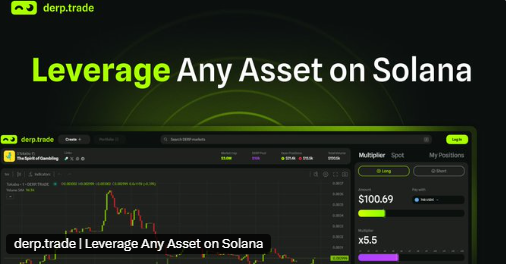
Derp.trade does not currently offer a dedicated native mobile app. The protocol is accessed primarily through its web interface at Derp.trade, but mobile trading is still possible through Solana wallet apps.
• Mobile access via Phantom: Phantom is available as both a browser extension and a mobile app. Mobile users can connect to Derp.trade through Phantom’s in-app dApp browser, which is the standard mobile DeFi experience for Solana applications.
• Solflare and Backpack alternatives: Solflare and Backpack also provide mobile apps with built-in dApp browser support, giving users multiple wallet options for accessing Derp.trade on mobile.
• Same on-chain experience: Mobile access uses the same underlying Solana mainnet contracts as desktop, so trades, positions, and PnL behave identically regardless of device.
• Beta-stage caveat: Derp.trade is still in beta, so traders should expect ongoing improvements to the mobile experience. A dedicated derp.trade mobile app may arrive in future releases but is not currently part of the documented product.
Derp.Trade Review: Usability
Derp.trade is designed to feel familiar to anyone who has traded perpetual futures elsewhere, while removing many of the friction points that come with order-book exchanges. The points below summarize the day-to-day usability of the platform based on the official documentation.
• No KYC or account creation: Onboarding takes minutes rather than hours. There is no email verification, no identity check, and no centralized account setup — connecting a Solana wallet is sufficient to start trading.
• Familiar trading layout: The interface follows a standard layout with a chart, a market selection panel, a long and short trading widget, and a positions panel below the chart that shows entry price, unrealized PnL, liquidation price, and accumulated funding for each open trade.
• Instant execution via AMM: There is no waiting for a counterparty, no partial fills due to thin order books, and no slippage from sweeping through multiple price levels on illiquid tokens.
• Pre-trade risk visibility: The interface clearly shows the notional position size and estimated liquidation price before the trade is confirmed, which helps traders manage risk before submitting the transaction.
• Beginner-friendly defaults: The docs recommend that first-time users start with low leverage (2x to 5x) and a small position size to build familiarity with the platform before scaling up.
• Predictable position lifecycle: Closing a position follows the same pattern — find the position in the positions panel, click Close, and approve the transaction in the connected wallet. PnL minus fees is returned as USDT.
• Beta-stage limitations: Market orders are supported today, while limit and stop orders are listed in the documentation as coming soon. This is a meaningful gap for traders who rely on conditional orders, and worth factoring into the workflow until the missing order types ship.
Derp.Trade Review: Comparison to Traditional Perpetual Exchanges
Derp.trade differs from traditional perpetual exchanges across several important dimensions, summarized in the documentation as a side-by-side comparison.
| Factor | Traditional Perps | DERPs (derp.trade) |
| Liquidity model | Order book — needs many buyers and sellers to function effectively. | AMM — always available, no minimum liquidity requirement. |
| Supported assets | Major tokens only such as BTC, ETH, and SOL. | Any token on Solana, including very low-volume assets. |
| Market creation | Requires exchange approval and deep liquidity bootstrapping. | Permissionless and free, listed in seconds. |
| Margin model | Cross or isolated margin available. | Isolated margin only. |
| Unique risk | Counterparty and exchange custody risk. | AMM payout risk specific to the protocol design. |
Derp.Trade Review: Conclusion
Derp.trade fills a real gap in the Solana derivatives market by enabling leveraged perpetual trading on any on-chain asset, including the long tail of low-volume tokens that order-book exchanges cannot support. Its AMM-based design removes the need for counterparties, permissionless market creation removes listing friction, and the 0.7% fee per side with no hidden costs keeps the economics straightforward. Beta limitations such as the absence of limit and stop orders and the lack of a native mobile app are real, but the core protocol is functional, on-chain, and worth watching as it matures.
Frequently Asked Questions
Can I create my own market on Derp.trade?
Yes. Anyone can list a new token market in seconds with zero fees. Market creators also earn 0.1% of trading fees on their market and 10% of liquidated equity from positions in that market, which incentivizes listing tokens with active trading interest.
Does Derp.trade require KYC or account creation?
No. Derp.trade does not require KYC, email verification, or any centralized account creation. Connecting a Solana wallet is sufficient to start trading, which is consistent with most decentralized perpetual protocols.
Is Derp.trade safe to use?
Derp.trade is live on Solana mainnet but still in beta, and leveraged trading is risky by design. The documentation explicitly warns that traders can lose their entire deposited collateral and recommends never trading more than they can afford to lose. The protocol also flags an AMM payout risk specific to its design, which is documented separately under its risk overview.
