


Ethereum Virtual Machine (EVM) has changed the world of blockchain technology. They are the most versatile application of the ethereum blockchain ecosystem. Moreover, with each passing update, EVMs are getting faster, more versatile, have bigger capacity, and are better at governance.
Telos Corporation has recently launched its newest Ethereum Virtual Machine, probably the strongest one ever. Yet another powerful EVM is that of The Cardano Blockchain. In this article, we will measure both of these in terms of Speed, Capacity, Decentralisation, Versatility, and Governance. If you invest in cryptocurrencies, this is your best guide on both, and therefore, here is a brief Telos vs Cardano comparison:
Summary
| Feature | Telos | Cardano |
| Speed | 0.5 seconds | 5 to 10 minutes |
| Capacity | 10000T/s | 257 T/s |
| Decentralization | Delegated Proof of Stake | Proof of Stake |
| Versatility | Solidity, Vyper, C++ | Solidity, Marlowe, Glow |
| Governance | ⅔ Consensus | Majority Consensus |
| Power Usage | 0.000001 kWh | 0.0007 kWh |
| Fees | 1-25 Cents(USD) | 3-40 Cents(USD) |
Let’s get some concepts refreshed.
What are Smart Contracts? How do they work?
EVMs are used to execute smart contracts. Smart Contracts are pieces of code that verify whether a certain condition is met. For example, in a decentralized auction, they would verify if the present bid is the highest one or not. Smart Contracts, being programs need some computers to run. These virtual computers are called Ethereum Virtual Machines.

What are EVMs? How do they work?
Ethereum Virtual Machines are the computation engines that work as decentralized computers.
These EVMs are installed in each node(CPU) in the ethereum network. You give them a command and they execute it. The difference is they only listen to their master(the coder who will create them). They are installed in each node and are interconnected through the Ethereum Network( for this article, Telos and Cardano).
Let us now dive into our comparison.
Telos vs Cardano: TELOS EVM
With the release of Telos EVM, the company has released one of the most powerful ethereum virtual machines to date. The Telos EVM can run smart contracts at many times the Speed of Ethereum. It is also Cheaper, has Better Governance, and has a much Higher Capacity than what Ethereum 2.0 is even trying to achieve.
The Telos EVM is not a fork on the original Go Ethereum code but has been developed from scratch. This results in much higher performance than other Ethereum alternatives. Telos has a highly scalable solution and also offers feature parity with Ethereum Blockchain.
Telos vs Cardano: Cardano EVM
The Cardano EVM was launched by the Cardano Foundation, founded by Ethereum co-founder Charles Hoskinson. Cardano is proof of stake blockchain with ADA as its coin. The Cardano EVM can run decentralized applications better than its original competitor Ethereum. It is faster has a smaller size for nodes, and aims or a million transactions per second.
This EVM was also designed with the same principles in mind. This is to overcome the limitations of Ethereum such as capacity, speed, governance, energy, ease of transactions, etc. Cardano EVMs are called KEVM where K means officially verified software.

Our Criteria:
We have decided to measure both Telos and Cardano based on the features which can be considered as their backbone. We believe to win in a highly competitive market, performing well on these features is a must. We will compare them based on:
- Speed
- Capacity
- Decentralization
- Versatility
- Governance
- Power Usage
- Fees
Telos vs Cardano: Speed
The main aspect of comparison in cryptocurrency platforms is speed. Ethereum was a major upgrade to Bitcoin and currently has a transaction speed of 14 seconds. Compared to this, Telos has a speed of just 0.5 seconds. Cardano on the other hand can make a transaction in 5 to 10 minutes which is significantly longer.
Telos vs Cardano: Capacity
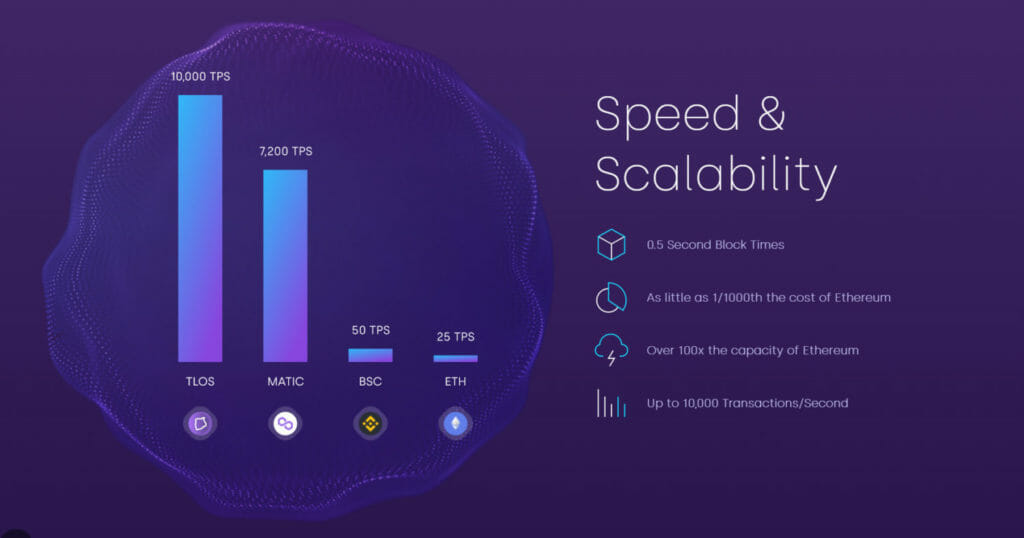
Telos has a capacity of more than 10,000 transactions per second as claimed by Jesse Schulman of CalEOS. They are the team that developed Telos. Cardano can handle 257 transactions per second. Both of them are way faster than the current capacity of Ethereum, which is 30 transactions per second.
Telos vs Cardano: Decentralization
Telos works on a delegated proof of stake which means users have delegated the job for verifying transactions to someone else. Telos has delegated to the Rex Resource Exchange. Cardano on the other hand has a proof of stake mechanism to verify transactions called Ouroboros.
Telos vs Cardano: Versatility
Telos can generate blocks for 95+ per cent of the dapps(Decentralised Applications) based on c++, solidity, and vyper. Cardano can run Solidity/Ethereum blocks currently and also on Marlowe for financial smart contracts and Glow for developing dapps.
Telos vs. Cardano: Governance
Telos:
- Jurisdiction – British Virgin Islands
- Native Unit(coin) -TLOS Token
- Producers(Transaction Verifier) – Currently 21 Block Producing Candidates as per Delegated Proof of Stake, 30 other Candidates
- Members – Any Telos user
- Modifying Blockchain Consensus- 2/3rd of members
Cardano:
- Jurisdiction – Switzerland
- Model – On-Chain Governance
- Native Unit(coin) -ADA Token
- Producers(Transaction Verifier) – Proof of Stake Mechanism
- Members- Any ADA holder
- Modifying Blockchain Consensus – Majority Consensus
Telos vs Cardano: Power Usage
A prime criticism of cryptocurrency was the too much power required in mining. With proof of stake mechanism, the usage of power has reduced drastically.
Having a delegated proof of mechanism Telos has reduced power consumption even further. It needs 0.000001 kWh per transaction while Cardano needs 0.0007 kWh per transaction(700 times more than Telos).Telos vs Cardano: Fees
This is perhaps the second important aspect of any cryptocurrency other than speed. The cryptocurrency revolution has succeeded because of its low fee requirements and high speed.
Telos has an average fee requirement of 1 cent(USD). Telos fees are fixed and do not vary with its coin price. Even the bulkiest transactions need 25 cents. Cardano needs 3 cents to max 40 cents gas fees, significantly higher than that of Telos and also vary with Coin Prices. Hence, buying Cardano makes less sense when you can do better with Telos.Conclusion:
Both Telos and Cardano have made excellent gains over their prime competitor Ethereum. Telos being a step ahead of Cardano leads in Gas Fees, Transaction Capacity, Speed, Power Usage, and Versatility. While Cardano has lagged in others, it performs better in Governance being a true decentralized and proof of stake ecosystem. Also, Cardano aims at 1 million transactions per second, which would propel it to newer heights.
