


This Payy network and wallet review covers what Payy actually offers as an onchain consumer banking stack. Payy combines a privacy-preserving UTXO-based blockchain — the Payy Network — with a non-custodial Payy Wallet to let users send, save, and spend stablecoins privately.
Payy Network and Wallet Review: What is Payy?
Payy is an onchain consumer banking platform built by Polybase Labs that vertically integrates stablecoins, a privacy-preserving blockchain, global fiat ramps, payment cards, and cross-chain DeFi into a single interface for consumers and businesses. It is positioned as a self-custodial alternative to traditional banking, where users store funds in the Payy Wallet with security and access guaranteed by cryptography rather than relying on a bank custodian.
Payy has two main components. The Payy Network is described as the first stablecoin payments chain with compliant privacy and built-in fiat ramps. It is currently implemented as a bespoke single-sequencer validium rollup on Polygon, with Ethereum support coming soon, and it aggregates UTXO transaction proofs and hashes submitted by Payy Wallet before posting them to the base layer.
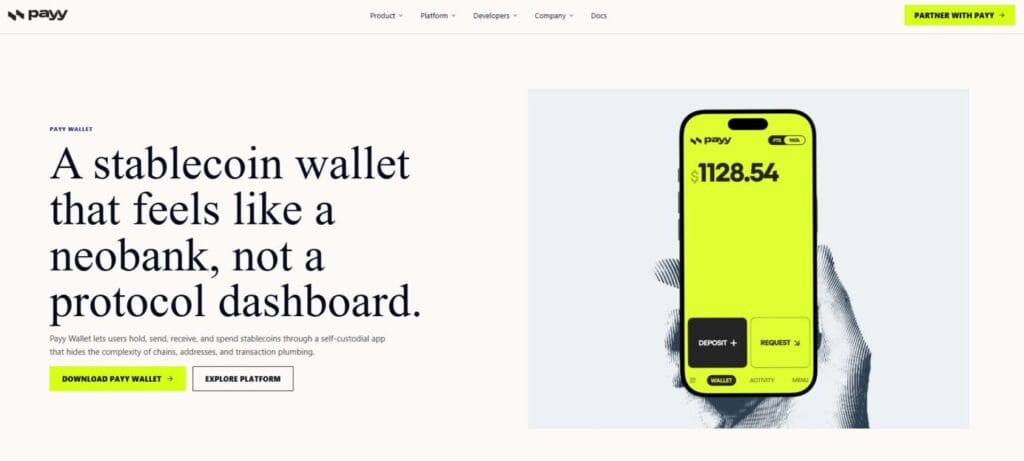
The Payy Wallet is a non-custodial banking app that automatically connects to Payy Network and sets up an account on first open. Together they allow users to deposit and withdraw funds and send and receive payments, with USDC as the primary balance held in the wallet. Importantly, the docs note that neither Payy nor Polybase Labs holds a banking license — Payy Wallet is software that lets users manage cryptographic keys, sign transactions, and interface with blockchains and partner services without giving up custody.


Payy Network and Wallet Review: Core Features
• Self-custodial banking: At no point do Payy or Polybase Labs have unilateral custody of user funds. The wallet manages cryptographic keys locally and signs transactions on the user’s device, providing bank-like services through a combination of decentralized blockchain systems and regulated partners.
• Compliant privacy through ZK proofs: Payy Network uses Zero Knowledge Proofs (specifically Halo2 circuits with HyperPlonk arithmetisation and KZG commitments) so that transaction amounts, sending addresses, and receiving addresses are never revealed publicly, while keeping the design space open for compliance through UTXO lineage tracing of past parent notes.
• UTXO-based architecture: The network uses an Unspent Transaction Output model (introduced by Bitcoin and used in Zcash) to support strict privacy constraints, with each note containing application type, authentication, value, and nullifier entropy fields.
• Validium rollup design: Only state hashes and ZK proofs leave the user’s device — the actual transaction data never does. The rollup state is stored in a sparse merkle tree on Polygon, which keeps the protocol private, scalable, and verifiable.
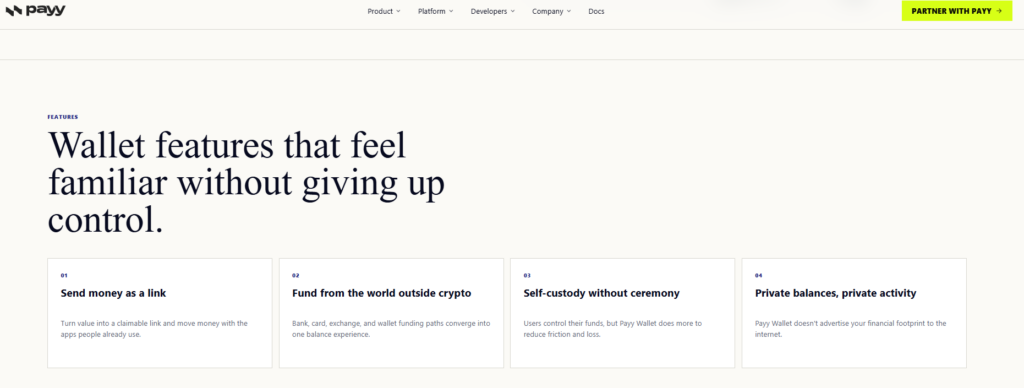
• Payy Links and QR payments: Payments via Payy Link or QR code transfer funds to a new ephemeral wallet embedded in the link, then transfer them out to the recipient when claimed. Even the sender’s Payy Address is never exposed to the network.
• Multi-chain address abstraction: Payy Wallet abstracts multiple addresses across multiple blockchains to orchestrate seamless payments, including deposit addresses on chains like Polygon that the wallet controls non-custodially for swapping and bridging into Payy Network.
• Native Ethereum address support: Payy Network natively supports Ethereum addresses, where the auth commitment is the Ethereum address and spending requires a ZK proof of ownership over the underlying private key.
• Payy Card with stablecoin spending: The Payy Card lets users spend stablecoins in everyday transactions, with a limited edition Light Up Card unlocked at 100,000 Payy Points and a Community Cards program for projects and foundations to launch branded cards.
• Payy Points reward program: Season 1 rewards balance points (1 USD held = 1 point per day) and 10,000 points per friend successfully invited who applies for a Payy Card, with future seasons noted as coming soon.
• Open-source ZK circuits and contracts: The ZK circuits and smart contracts powering Payy are open source and published at github.com/polybase/payy, allowing anyone to audit the protocol’s privacy and compliance logic.
Payy Network and Wallet Review: Fees
The official documentation does not publish a granular trading or transaction fee schedule for Payy. Instead, the $PAYY tokenomics page describes the user experience as “easy for normal users — just send, save, spend, no fees.”The cost picture that does appear in the docs is summarized in the table below.
| Fee Type | Amount | Details |
| Send, save, spend on Payy | Documented as no fees | The tokenomics page describes the normal user experience as send, save, spend with no fees. A detailed schedule is not published in the documentation reviewed. |
| Deposit / Withdraw | Underlying network gas | Deposits and withdrawals involve bridging between Payy Network and the underlying base layer (currently Polygon), so standard network transaction fees on the source or destination chain apply. |
| Identity verification (KYC) | Free and optional | KYC is optional and only required for regulated financial services such as fiat bank transfers and payment cards, not for crypto deposits, withdrawals, or stablecoin payments. |
| Payy Card unlock | 100,000 Payy Points | The Light Up Payy Card is unlocked through Payy Points (earned via balance and invites), not a direct cash purchase. Shipping takes 2 to 4 weeks once unlocked. |
| $PAYY token benefits | Variable | Holding $PAYY is documented as giving tiered benefits — better yield, credit, execution, leverage, and additional privacy — but specific fee discounts or thresholds are not detailed in the public docs. |
Anyone evaluating Payy for high-volume use should treat the “no fees” framing as the headline retail pitch and verify any operational costs (bridge fees, partner spreads on fiat ramps, card interchange) directly with Payy support before committing to large flows. The documentation reviewed does not list those costs.
Payy Network and Wallet Review: How to Get Started With Payy?
Onboarding to Payy is unusually simple by crypto standards because the wallet handles network setup automatically. The documentation describes a four-step path from download to first payment.
Step 1: Download the Payy Wallet
The Payy Wallet is available. There is no separate web onboarding flow — the wallet itself is the entry point to the entire Payy ecosystem, and it is described as “an enshrined non-custodial banking app on Payy Network.”
Step 2: Open the wallet for automatic setup
On first open, Payy Wallet automatically connects to Payy Network and sets up the user account. There is no seed phrase ceremony to step through manually before transacting — the wallet handles cryptographic key generation in the background, and the Key Backup section covers how to secure those keys afterwards.
Step 3: Deposit funds into the wallet
Users can deposit USDC by sending tokens to a deposit address on a supported chain such as Polygon. The Payy Wallet picks up the deposit and bridges it to Payy Network non-custodially, so funds appear in the user’s Payy balance after the bridge completes. The user’s primary balance in Payy is held as USDC, the stablecoin issued by Circle and redeemable 1:1 for US dollars.
Step 4: (Optional) Verify identity for fiat services
Identity verification is optional and only needed to unlock regulated services like fiat bank transfers and payment cards. Crypto deposits, withdrawals, and stablecoin payments do not require KYC. When a user does verify, they submit information such as legal name, birthdate, address, and an ID photo, but the docs note that it is cryptographically impossible to link this data to Payy Network activity because the wallet does not expose balances, transaction amounts, or Payy Addresses to the network.
Step 5: Send, save, or spend
Once funded, users can send payments via Payy Links or QR codes (which use ephemeral wallets to keep details private), receive payments from other Payy users, hold USDC as savings, or spend through the Payy Card once it is unlocked through the Payy Points program.
Payy Network and Wallet Review: Mobile App
Payy is delivered primarily as a mobile-first non-custodial banking app. The download page at payy.link/download is the primary distribution channel for the wallet, and the documentation describes it as the user’s main interface to the entire Payy stack.
• Mobile-first product: Payy Wallet is positioned as the consumer-facing app for the Payy ecosystem, not a desktop dashboard.
• Auto-configured on first open: When the wallet is opened for the first time, it automatically connects to Payy Network and sets up the user’s account — no manual chain configuration, RPC entry, or seed phrase ceremony before transacting.
• Built-in privacy layer: All transaction data stays on the user’s device. The only data that leaves the wallet is an updated state hash and a ZK proof, which means privacy is enforced at the device level rather than depending on user settings.
• Native send and receive: Users can send payments via Payy Links and QR codes that use ephemeral wallets to keep amounts and addresses confidential, even from chain analysis tools.
• Card and points integration: The Payy Card and Payy Points programs are managed inside the wallet, so card unlocks, balance tracking, invite rewards, and shipping status all live in the same app.
• Open-source backend: The ZK circuits and smart contracts that the app interfaces with are published on GitHub at github.com/polybase/payy, allowing security-minded users to verify the cryptography behind the mobile app.
Payy Network and Wallet Review: Usability
Payy is positioned as a consumer-friendly banking app, not a power-user crypto wallet. The documentation emphasizes simplicity for normal users while keeping advanced privacy and compliance machinery hidden behind the scenes. The points below summarize the day-to-day usability based on the docs.
• “Money is hard” framing: It explicitly frames the product around making saving, spending, and investing easier compared to traditional banking, where saving is hard when users can be debanked and spending is hard with delays and restrictions.
1• Single interface for the full stack: Stablecoins, fiat ramps, payment cards, and cross-chain DeFi are accessible through one app, instead of stitching together a wallet, an exchange, a card provider, and a yield protocol.
• Privacy without manual setup: Users do not need to choose between transparency and privacy. The default mode of every transaction is private, with compliance handled through UTXO lineage rather than user-facing toggles.
• Optional KYC where it makes sense: KYC is required only when accessing regulated services like fiat bank transfers and Payy Cards. Stablecoin payments and on-chain deposits and withdrawals do not require it, which keeps friction low for users who only need crypto-native functionality.
• USDC-denominated balances: The wallet’s main balance is held as USDC, which keeps the user experience close to a US dollar account in feel — 1 USDC is generally equivalent to 1 US dollar — so users do not have to mentally translate balances between volatile crypto and fiat.
• Self-custody guardrails: Because the wallet is non-custodial, users are responsible for key backup. The Key Backup section of the docs is its own dedicated topic, signaling that this is the most important user-side responsibility for protecting funds.
• Network still maturing: Payy Network currently runs as a single-sequencer validium rollup on Polygon, and node operators are private and invite-only at the time of writing, with public node operation expected later. Users should factor this stage of decentralization into their risk assessment.
Payy Network and Wallet Review: How Payy Differs From Tornado Cash and Zcash
One of the most distinctive parts of this Payy Network and Wallet Review— and a reasonable thing for any reviewer to call out — is its compliance-aware approach to privacy. Payy is different from products and protocols pushing for absolute privacy like Zcash, Monero, and Tornado Cash. The team’s goal is to keep the design space open so the protocol can adapt to changing technology and regulation, while still delivering meaningful privacy for normal payments.
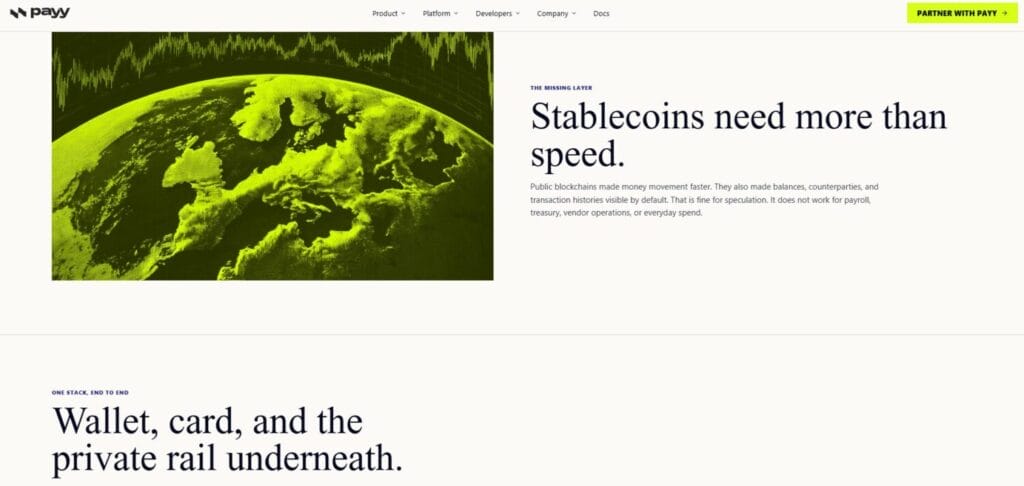
The mechanism Payy uses for this is called UTXO lineage. For any given UTXO note, all of its past parent notes can be traced, which gives regulators and partners a tool for following the provenance of funds when needed. At the same time, the transaction amount, sending address, and receiving address are still never revealed publicly. For consumer banking use cases such as payroll, contractor payments, royalty payments, and trade finance — explicitly listed in the privacy section of the docs — this hybrid model is the entire point of the product.
Payy Network and Wallet Review: Conclusion
Payy is one of the more ambitious onchain consumer banking attempts documented today, combining a privacy-preserving UTXO rollup with a non-custodial wallet, USDC balances, a payment card, and a points program inside a single mobile app. The compliant-privacy approach via UTXO lineage is a thoughtful middle path between fully transparent and fully shielded chains, and the open-source ZK circuits add credibility. Network-stage caveats around the single-sequencer validium and invite-only node operators are real, but for retail users wanting private stablecoin payments, Payy is worth tracking closely.
Frequently Asked Questions
Is Payy audited?
Dedicated Audits section under Support, and the ZK circuits and smart contracts powering Payy are open source on GitHub at github.com/polybase/payy, which allows external review of the cryptography and contracts beyond formal audits.
Where can I view Payy Network activity?
The official Payy Network explorer is available at payy.network/explorer. Activity is visible only as hashes and proofs because the actual transaction data is private and never leaves the user’s device, which means the explorer cannot display amounts, sending addresses, or receiving addresses.
Can I run a node on Payy Network?
Public node operation was not yet available at the time of the documentation reviewed. The docs note that the ability to run sequencer or prover nodes is expected to become available later, with a sign-up form at tally.so/r/wzjJPa for users who want to be notified when public participation opens.
