


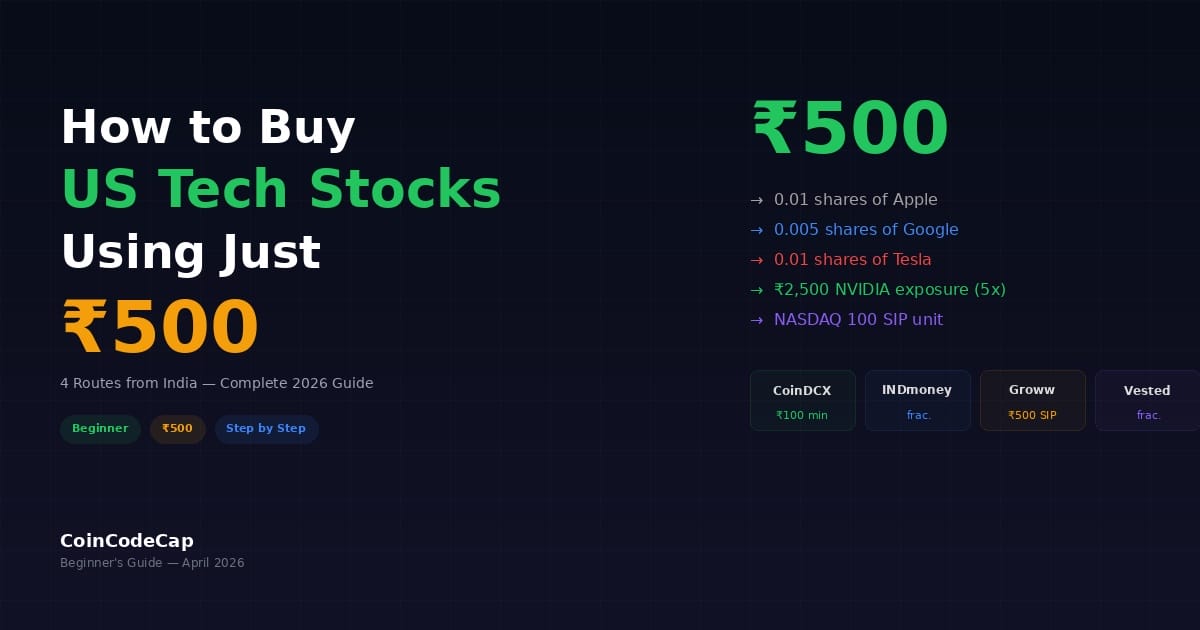
The single biggest myth in Indian investing is that you need lakhs of rupees to buy US stocks. You don’t. You need ₹500. Literally ₹500 — less than a Zomato dinner for two — and you can own a piece of Apple, trade NVIDIA with leverage, or start a monthly SIP into the NASDAQ 100.
I started my US stock journey with ₹3,000 on CoinDCX. My first trade was a long position on NVIDIA at 3x leverage with ₹1,000 margin. I made ₹310 in four hours when NVIDIA moved 2.1%. That ₹310 profit was enough to convince me that US stocks weren’t just for NRIs and HNIs. They’re for anyone with a smartphone and ₹500.
This guide covers every route to get started with the absolute minimum — not theoretical minimums, but the practical amount you actually need after all fees, spreads, and conversion costs. I’ve tested every platform mentioned here with my own money.
Four routes, four minimum amounts, four different experiences
₹500 buys you…
₹2,500 exposure
CoinDCX at 5x leverage
0.022 Apple shares
INDmoney / Vested
0.016 Tesla shares
INDmoney / Vested
1 NASDAQ SIP unit
Groww / Zerodha
Route 1: CoinDCX — ₹100 minimum, trade immediately
CoinDCX is the fastest and cheapest entry point into US tech stocks from India. The minimum deposit is ₹100. With leverage, that ₹100 becomes up to ₹2,000 in stock exposure (at 20x, though I’d never recommend 20x). At a practical 5x, ₹500 gives you ₹2,500 of NVIDIA, Apple, Tesla, or any of the 20+ stocks available.

The step-by-step for your first ₹500 on CoinDCX:
1. Download CoinDCX. If you already trade crypto, tap “US Futures” — your existing KYC is already approved.
2. New users: submit PAN + Aadhaar. KYC clears in 12 minutes during off-peak hours.
3. Fund your US Futures wallet. Open your banking app, send ₹500 via IMPS to CoinDCX’s bank details. Clears in 3-6 minutes. (No UPI yet — annoying, I know.)
4. Search for NVDA (NVIDIA). Tap “Long.” Set margin to ₹500. Set leverage to 3x (₹1,500 exposure). Set stop-loss at 5% below current price. Confirm.
5. Your position is live. You’re now trading NVIDIA with Indian rupees from your phone.
What you get: Price exposure to US stocks, not actual ownership. You profit when the stock moves in your direction. You don’t receive dividends, can’t vote at shareholder meetings, and don’t have SIPC protection. What you DO get that nobody else offers: leverage (amplified returns), short selling (profit from declines), and 24/7 trading access.
What ₹500 at 3x leverage looks like in practice: ₹1,500 exposure to NVIDIA (~$18). If NVIDIA moves 3% in your direction, you make ₹45 (9% on margin). If it moves 3% against you, you lose ₹45. Small numbers — but this is how you learn the mechanics before sizing up. Every professional trader I know started with small positions.
The catch: Funding rate. CoinDCX charges 4-8% annualised on open positions. On ₹500 exposure, that’s roughly ₹0.05-0.11 per day — negligible. But if you scale up to ₹50,000 positions held for weeks, the funding rate matters. CoinDCX is for trading (days), not investing (years).
Route 2: INDmoney — $1 fractional shares via UPI
INDmoney is the best platform for someone who wants to actually own Apple, Google, or Tesla shares (not derivatives) and wants to pay via UPI.
Fractional shares explained for beginners. Apple stock costs $270 (roughly ₹23,000). You don’t need ₹23,000. INDmoney lets you buy $1 worth of Apple — that’s 0.0037 shares, or about ₹85. You own actual fractional equity in Apple Inc. If Apple goes up 10%, your $1 becomes $1.10. If Apple pays a $0.26 quarterly dividend, you receive $0.001 (proportional to your 0.0037 shares). It’s not a lot, but it’s real ownership that compounds over time.
The step-by-step for your first ₹500 on INDmoney:
1. Download INDmoney. Complete digital KYC (PAN + Aadhaar + selfie). Takes 10 minutes.
2. Navigate to “US Stocks.” Tap “Add Money.” Select UPI.
3. Pay ₹1,000 via Google Pay, PhonePe, or Paytm. (I recommend ₹1,000 minimum because the forex conversion costs eat into very small amounts.)
4. Wait for LRS processing and INR → USD conversion. First time: ~24 hours. Subsequent: 4-6 hours.
5. Once USD is credited, search “AAPL” (Apple). Tap Buy. Enter $6 (~₹500). Buy during US market hours (7 PM to 1:30 AM IST).
6. You now own 0.022 shares of Apple. Check your portfolio in the morning.
The Stock SIP feature is INDmoney’s killer advantage. Set up automatic monthly purchases — $10 of NVIDIA, $10 of Apple, $10 of Google — funded via UPI autopay. This is identical to a domestic mutual fund SIP experience, but for individual US stocks. ₹500/month into three stocks means you’re dollar-cost averaging into the world’s largest companies for the price of two coffees.
Cost reality check: INDmoney charges no brokerage fee. But the forex conversion spread is 0.5-1.2%. On ₹500, that’s ₹2.50-₹6.00 lost to conversion. Not significant, but over monthly SIPs it adds up. Annual cost on ₹6,000 invested (₹500/month): approximately ₹30-72 in forex. Compare that to the 1-1.5% expense ratio on Indian mutual funds — INDmoney is cheaper for direct stock ownership.
Route 3: Vested Finance — $1 fractional shares with SIPC protection
Vested Finance offers the same fractional share capability as INDmoney but with a different strength: SIPC protection up to $500,000 (including $250,000 for cash). This means if Vested’s US custodian (DriveWealth) goes bankrupt, your shares are protected up to half a million dollars. For small amounts, this doesn’t matter. But as your portfolio grows, it matters a lot.
Why I use Vested over INDmoney for large holdings: I hold my core Apple, Google & Tesla positions on Vested because the security is higher. SIPC protection is the US equivalent of DICGC for bank deposits — it’s institutional-grade insurance. INDmoney is also regulated (IFSCA), but the SIPC layer is a meaningful differentiator.
The catch for ₹500 investors: Vested doesn’t support UPI. You need to do a bank wire transfer, which takes 2-3 business days for the first remittance. For someone starting with ₹500, this is a lot of friction for a small amount. My recommendation: start with CoinDCX or INDmoney, then migrate to Vested when your US stock allocation exceeds ₹25,000.
CoinDCX vs. Vested comparison | CoinDCX vs. INDmoney comparison
Route 4: Groww/Zerodha mutual fund SIP — ₹500/month, zero friction
This is the route I recommend for absolute beginners who don’t want to think about stocks at all. Set up a ₹500/month SIP into Motilal Oswal NASDAQ 100 Index Fund or Motilal Oswal S&P 500 Index Fund on Groww. UPI autopay deducts automatically. You never touch a bank remittance form. You never deal with forex. You never open a US brokerage account.
What you actually own: Mutual fund units in an Indian fund that holds US stocks. The fund house handles the LRS remittance and dollar purchases internally. You get rupee-denominated returns that track the NASDAQ 100 or S&P 500 with a small tracking error (0.5-1.5% annually).
The composition: A ₹500 NASDAQ 100 SIP gives you indirect exposure to Apple (7%), NVIDIA (6%), Microsoft (8%), Google (5%), Amazon (5%), Tesla (3%), Meta (4%), Broadcom (4%), Netflix (2.5%), and 90+ other companies. For ₹500 per month, that’s extraordinary diversification.
Cost: Expense ratio: 0.5-1% annually. On ₹6,000 invested per year, that’s ₹30-60. No entry/exit load. No TCS (domestic transaction). Tax: treated as non-equity MF — gains taxed at 12.5% after 24 months.
What happens to ₹500 over 1, 3, and 5 years
Let me run the math on each route, assuming historical average returns (not guaranteed — these are backtested projections).
🎯 Beginner’s ₹2,000/Month US Tech Portfolio
| CoinDCX | ₹500 → NVIDIA trades (3x leverage, earnings plays) | Active trading |
| INDmoney | ₹500 → $3 each in Apple + Google (UPI Stock SIP) | Ownership |
| Groww SIP | ₹500 → NASDAQ 100 Index Fund (UPI autopay) | Passive index |
| Reserve | ₹500 → Bank savings (for scaling up later) | Dry powder |
₹2,000/month across three platforms. Active trading + ownership + passive index. Scale each layer as you learn.
CoinDCX (₹500 monthly, reinvested profits at 2% monthly return): This is speculative — trading returns vary wildly. At 2% monthly net return (after fees and losses), ₹500/month for 5 years grows to approximately ₹48,000. At 0% (break-even), it stays at ₹30,000. At -2% (losing trader), it shrinks to ₹18,000. Most leveraged traders lose money, which is why I recommend limiting CoinDCX to 25% of your US stock budget and using it to learn, not to compound.
INDmoney fractional shares (₹500/month in Apple, 12% CAGR): After 1 year: ~₹6,400. After 3 years: ~₹21,500. After 5 years: ~₹41,200. These are real, compounding ownership returns. Apple has returned roughly 15% annualised over the past decade — I’m using a conservative 12%.
Groww NASDAQ 100 SIP (₹500/month, 14% CAGR): After 1 year: ~₹6,500. After 3 years: ~₹22,800. After 5 years: ~₹45,300. The NASDAQ 100 has averaged ~16% annualised over the past decade. At 14% (accounting for expense ratio and tracking error), a ₹500 SIP compounds to ₹45,000 in 5 years. That’s 2.5x your total investment of ₹30,000.
The lesson: For ₹2,000/month split across routes, your 5-year projected portfolio (at historical returns) is approximately ₹1.2-1.5 lakhs from ₹1.2 lakhs invested. The returns are modest in absolute terms, but the education is priceless. By year 2-3, you’ll have enough experience to scale confidently into ₹10,000-₹50,000 monthly allocations.
Which US tech stocks to start with on ₹500 — my ranked picks
| Route | Min Amount | What You Get | Time to Start | Best For |
|---|---|---|---|---|
| CoinDCX US Futures | ₹100 | Futures contracts (leveraged) | Same day | Active trading |
| INDmoney (UPI) | $1 (~₹85) | Fractional shares (actual ownership) | ~24 hours | UPI + Stock SIP |
| Vested Finance | $1 (~₹85) | Fractional shares (SIPC protected) | 2-3 days (first) | Long-term holds |
| Groww MF SIP | ₹500/month | Mutual fund units (indirect) | Instant | Zero-effort passive |
For CoinDCX (trading)
- NVIDIA — Best combination of volatility and fundamental clarity. May 20 earnings is the next big catalyst.
- Tesla — Most volatile. April 22 earnings. Start with paper trades or ₹100 positions.
- Google — Cheapest Mag 7 at 22x P/E. Less exciting but more forgiving of mistakes.
For INDmoney/Vested (ownership)
- Apple — The safest long-term hold. 1B+ services subscribers. Dividend payer. ATH territory.
- Google — AI re-rating underway. TPU revenue reaching $13B by 2027.
- VOO (Vanguard S&P 500 ETF) — If you can’t decide, buy the entire market. $1 minimum.
For Groww SIP (passive)
- Motilal Oswal NASDAQ 100 Index Fund — Tech-heavy. ₹500/month minimum.
- Motilal Oswal S&P 500 Index Fund — Broader diversification. ₹500/month.
Common mistakes ₹500 investors make (I made all of these)
⚠️ Starting Small Doesn’t Mean Risk-Free
₹500 is a small amount to lose, which is exactly why it’s perfect for learning. But the habits you build with ₹500 determine whether you succeed with ₹50,000. Always use stop-losses on CoinDCX — even on ₹100 trades. Never invest money you need for rent, EMIs, or emergencies. US stocks dropped 25-35% in 2022 — it can happen again. The NASDAQ 100 requires patience through drawdowns.
Mistake 1: Using 20x leverage on CoinDCX because “it’s only ₹500.” At 20x on ₹500, a 5% adverse move wipes you out completely. Your ₹500 becomes ₹0 in minutes. Start at 2-3x. Seriously.
Mistake 2: Checking fractional share returns hourly. You own 0.022 Apple shares worth ₹500. A 1% daily move is ₹5. Watching it every hour is the fastest way to develop anxiety about something that doesn’t matter until year 3.
Mistake 3: Skipping the SIP. The ₹500 NASDAQ 100 SIP on Groww is the single most important thing in this guide. Not because of the returns — because of the habit. Once you automate a ₹500 SIP, you never think about it again. In 5 years, you’ll have ₹45,000+ without a single active decision.
Mistake 4: Trying to trade Tesla on CoinDCX as your first trade. Tesla moves 5-8% daily. At 3x leverage, that’s 15-24% swings on your margin. Your first CoinDCX trade should be Apple or Google — stocks that move 1-3% daily. Learn the interface on something calm before touching Tesla.
Mistake 5: Ignoring tax implications. Even ₹500 investments in US stocks must be declared in Schedule FA of your ITR if held on LRS platforms (Vested, INDmoney). CoinDCX and Groww MF SIPs don’t require Schedule FA. The TCS threshold is ₹10 lakh — your ₹500 won’t trigger it, but know the rule for when you scale up.
Scaling up: the ₹500 → ₹50,000 roadmap
Month 1-3 (₹500/month): Learn the platforms. Set up Groww SIP. Make 3-5 CoinDCX trades with ₹100-500. Buy your first fractional shares on INDmoney. Total invested: ~₹1,500.
Month 4-6 (₹2,000/month): Increase CoinDCX allocation for earnings trades. Add Apple and Google to INDmoney Stock SIP. Keep Groww SIP running. Total invested: ~₹7,500.
Month 7-12 (₹5,000/month): Open Vested for core holdings. Move from INDmoney to Vested for amounts over ₹25,000 (SIPC protection). Start trading defence stocks and AI stocks on CoinDCX. Experiment with short selling. Total invested: ₹37,500.
Year 2+ (₹10,000-₹50,000/month): You now understand leverage, funding rates, fractional shares, forex costs, tax implications, and market cycles. You’ve survived at least one 10% correction. Scale with confidence.
FAQs
Can I buy US stocks with just ₹500 from India?
What is the minimum investment for US stocks from India?
₹100 on CoinDCX (leveraged futures). $1 (~₹85) on INDmoney/Vested (fractional shares). ₹500/month on Groww/Zerodha (mutual fund SIP). CoinDCX is cheapest but gives futures exposure, not ownership.
Which US stocks should a ₹500 beginner buy?
For trading (CoinDCX): Start with NVIDIA or Google — moderate volatility, clear catalysts. Avoid Tesla initially. For ownership (INDmoney): Apple — safest long-term hold. For passive: NASDAQ 100 or S&P 500 SIP.
Is ₹500 too little to invest in US stocks?
No. ₹500/month in NASDAQ 100 SIP for 5 years at 14% CAGR grows to ₹45,300 (on ₹30,000 invested). The amount matters less than the consistency. Start small, build the habit, scale when confident.
Do I need an LRS declaration for ₹500?
Not for CoinDCX (INR-settled, no forex) or Groww mutual fund SIPs (domestic transaction). For INDmoney/Vested (actual shares), yes — but LRS is processed automatically by the platform. TCS only applies above ₹10 lakh per financial year.
Start with ₹500. Own the World’s Best Companies.
CoinDCX: ₹100 to trade · INDmoney: $1 to own · Groww: ₹500/month SIP
