


If you’ve ever used DeFi for more than a few minutes, you’ve felt the frustration: your yield changes constantly, sometimes rising when you’ve already locked in, sometimes falling just after you jumped in. Unlike traditional finance, where interest rates are actively traded, DeFi has mostly treated yield as a passive by-product. Rate-X takes a radical step: it transforms yield itself into an asset you can buy, sell, long, short, or lock in. By separating principal from yield and layering leverage, Rate-X transforms interest rates into markets. This article examines Rate-X in depth, covering its origins, mechanics, risks, and its future trajectory.
Origins, Context, and Where Rate-X Fits
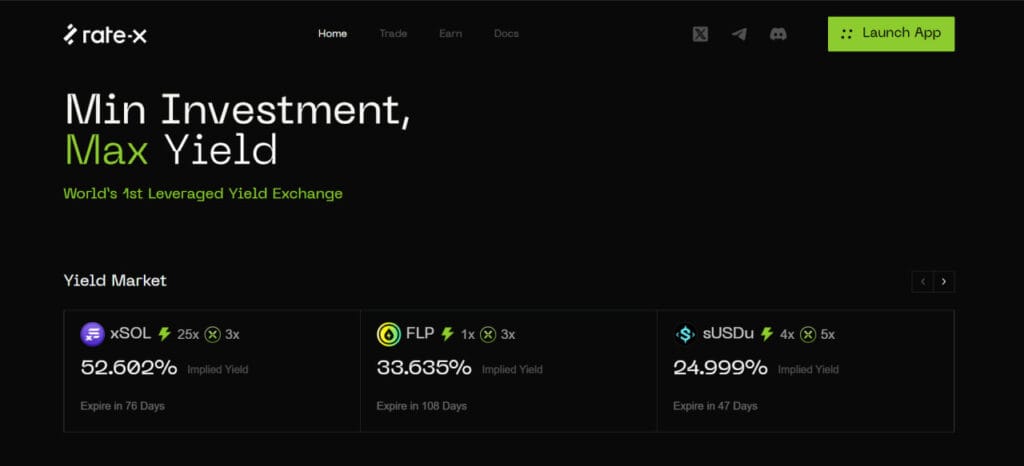
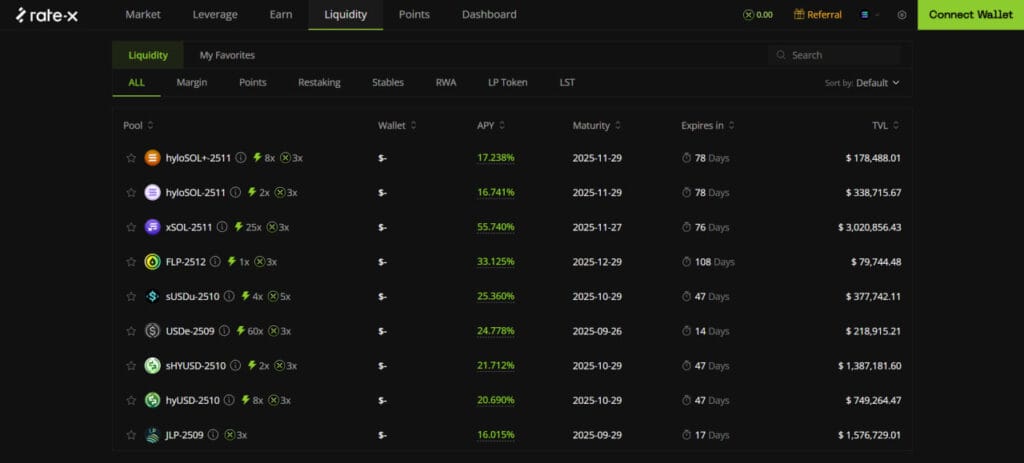
Rate-X brands itself as a leveraged yield trading exchange. Its core idea is simple but bold: in the same way bond traders buy and sell interest rates, crypto users should be able to buy and sell DeFi yield. The protocol’s roots are on Solana, though an earlier version appeared on BNB Chain. By mid-2025, most of its Total Value Locked (TVL) was on Solana, where liquid staking tokens (LSTs), liquid restaking tokens (LRTs), and Solana-native yield assets were booming. Solana’s low latency, low fees, and growing yield ecosystem made it an ideal fit for a rate-trading venue.
Funding also gives context. In 2024, Rate-X announced a seed round backed by major names: GSR, SNZ, Presto Labs, Animoca Ventures, Initial Ventures, G Ventures, KuCoin Ventures, Summer Ventures, and LeadBlock Bitpanda Ventures. This matters because leveraged derivatives markets require deep, continuous liquidity and often need market makers. Having backers with market-making pedigree suggests the team understood from the start that liquidity provision, not just flashy design, determines survival.
Security has been a recurring concern in DeFi, especially for leveraged protocols. More importantly, the report explained Rate-X’s epoch updates and its loss waterfall. Audits don’t guarantee safety, but they’re table stakes for protocols involving leverage and margin. Rate-X sits in the niche between staking platforms and derivatives venues. It isn’t a lending market like Aave or a DEX like Orca—it’s more like an interest-rate futures exchange for DeFi. That positioning explains its mechanics.

Also Read: 8 Best Blockchain Development Companies
Tokenisation of Yield: The Big Idea
Three Faces of the Same Asset
Imagine you deposit 1 SOL into a staking protocol. Normally, that grows into principal + yield. Rate-X slices this economic life into two pieces:
- Standard Token (ST): a rebasing token that tracks both principal and accrued yield. Think of it as “the whole pie.”
- Yield Token (YT): the right to future yield from one ST until a set maturity date. As time passes and yield accrues, YT’s value decays toward zero.
- Principal Token (PT): a conceptual helper token. It’s what remains if you strip out YT from ST. At maturity, PT equals one ST. Economically, it’s like a zero-coupon bond that matures at full value when time runs out.
Rate-X uses an implied yield framework: PT’s price reflects the discounted value of ST at maturity; YT = 1 − PT. In short, YT tracks expectations of future yield, while PT tracks discounted principal.
Also Read: How to Create a DApp on Ethereum using Solidity?
Why Synthetic Issuance Matters
Competitors like Pendle, Element, or Spectra/APWine require you to deposit real yield-bearing assets before minting PT/YT. That caps YT supply at however many deposits enter the vault. Rate-X, by contrast, allows synthetic minting against collateral. The benefits:
- Deposits do not cap YT liquidity.
- Users can short yield directly by minting and selling YT.
This design is critical. For a true two-sided market, you need both longs and shorts. If nobody can short, the market tends to skew toward long positions. Rate-X ensures structural symmetry, closer to how bond futures or interest-rate swaps work in TradFi.
Also Read: Hylo Protocol Review: The Solana DeFi
Markets, Expiries, and Assets You Can Trade
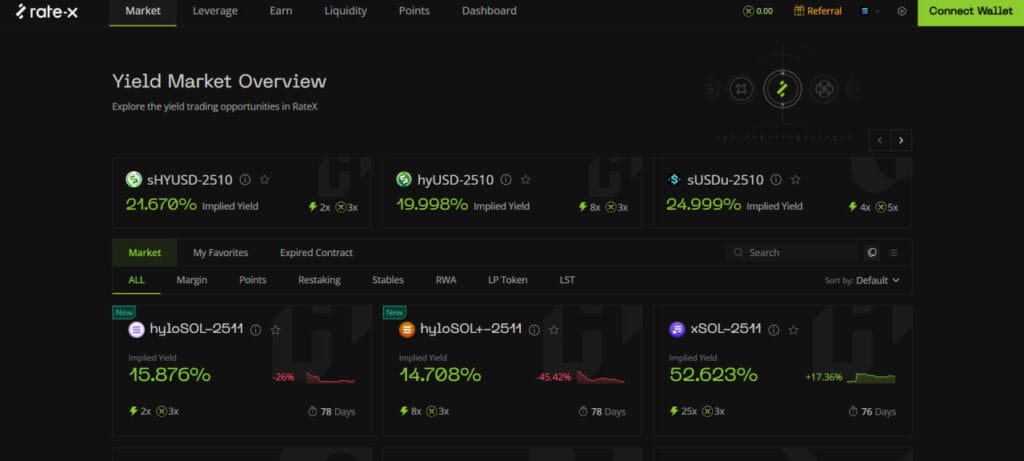
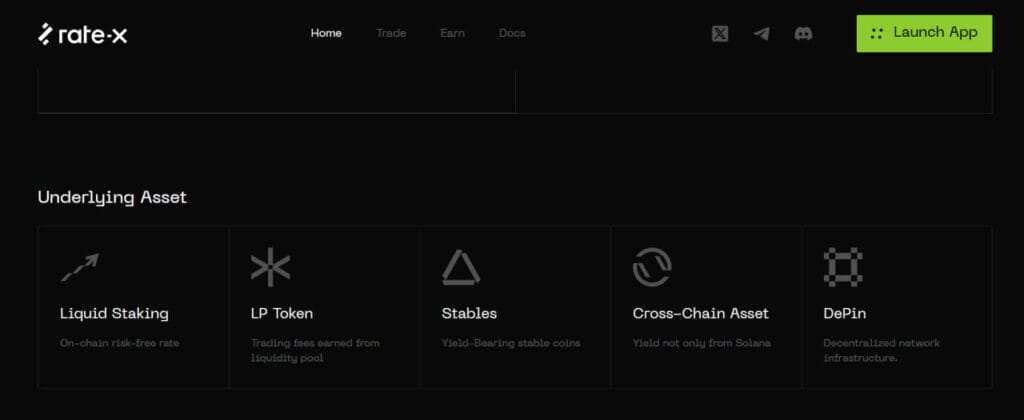
Every Rate-X market has two coordinates: the underlying yield-bearing asset (YBA) and the maturity date. A market might be called “JitoSOL-2506” (JitoSOL yield expiring June 2025). Assets include JitoSOL, bbSOL, BNSOL, JLP, and yield-bearing stablecoins like USDe/sUSDe. Each market is linked to a vault and program address on Solana, ensuring on-chain transparency.
Why does expiry matter?
Because YT value evaporates at maturity. If you hold YT, you only receive yield until that date. Afterwards, the yield stream is gone; the ST you hold is effectively just principal (like PT). This time-boxed design makes Rate-X markets behave like bond contracts, not perpetual swaps.
Also Read: 9 Best Solana DEX Platform
Minting, Collateral, and the Balance Sheet of Traders
When users mint ST and YT, they create economic obligations:
- LPs mint when they deposit YBAs. They receive ST plus the right to mint YT up to an AR-coefficient cap. Their balance sheet becomes +ST +YT, −yield obligations.
- Longs mint ST (using margin), swap it for YT, and gain exposure to rising yields.
- Shorts mint YT, swap it for ST, and profit if yields fall.
Every minting action is collateralised. If collateral becomes insufficient, the liquidation engine activates. This mirrors futures markets: every long is balanced by a short, and collateral ensures obligations are met.
Also Read: 5 Best Solana Auto Sell Bots
The Matching Engine: AMM + DLOB
AMM Core
At its heart, Rate-X uses a constant-product AMM (x·y = k), where x = YT, y = ST. The YT price is y/x. Like Uniswap v3, liquidity can be concentrated in chosen ranges, improving efficiency since yields don’t swing as wildly as token prices.
Time-Decay Logic
Unlike normal AMMs, Rate-X’s AMM rebases over time. After each epoch (a yield period), it rebalances YT and ST quantities so that YT reflects its decayed intrinsic value. Extra ST generated by this rebalance flows back to LP vaults. This keeps the market aligned with reality: YT shrinks as time passes.
DLOB Overlay
On top, a Decentralised Limit Order Book (DLOB) lets traders place precise orders. Keepers monitor it, match orders, and interact with the AMM for execution. This hybrid design balances always-on liquidity with granular control, mimicking the feel of an exchange rather than a pure AMM.
Price Cages
YT prices approach zero near expiry, making manipulation tempting. To dampen this, Rate-X uses a ±10% “price cage” around a 24-hour TWAP. Prices can’t move outside that band until the TWAP shifts. It’s a brake against expiry-time games.
Also Read: DeFi Yield Farming and Liquidity Mining
Leveraged Yield Trading: Going Long or Short
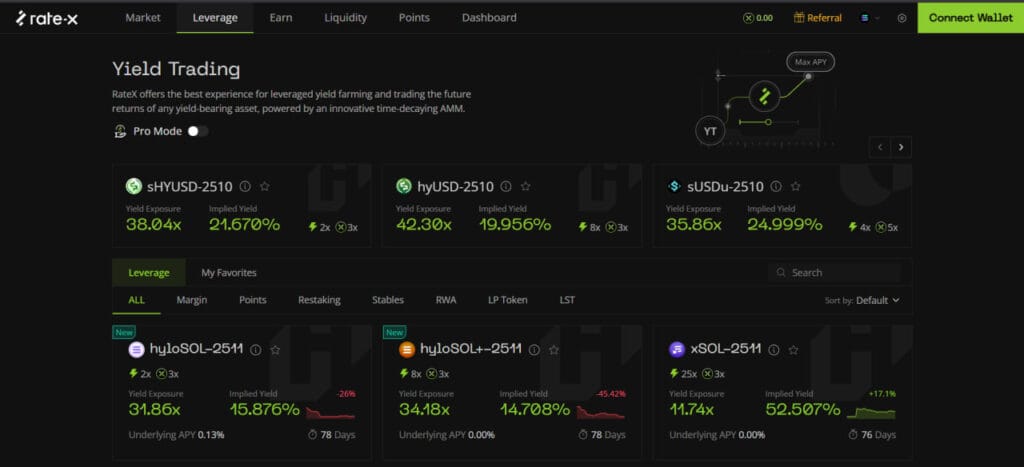
Trading on Rate-X is margin-based.
- To go long yield, you mint ST, then swap for YT. If implied yields rise, YT gains value, and you profit.
- To go short yield, you mint YT, swap for ST. If implied yields fall, YT loses value, and you profit.
Example: Deposit 1 SOL margin, borrow 10 ST, and swap for 100 YT. If YT’s price rises from 0.07 to 0.09 (implied APY rises), your 100 YT nets 2 units of gain. Leverage magnifies this: a small rate shift produces an outsized P&L.
Also Read: Crypto loans without collateral | Check NOW!
Collateral Ratios and Liquidation
Each position must maintain a Collateral Ratio (CR). Two thresholds apply:
- Initial CR: required at opening.
- Maintenance CR: enforced continuously, based on TWAP to avoid short-term manipulation.
If CR falls below maintenance, liquidation begins.
Liquidation Waterfall
- Insurance fund absorbs the loss.
- If insurance fails, Auto-Deleveraging (ADL) trims profitable opposing traders at the bankruptcy price.
- If gaps remain, LPs absorb socialized loss.
This design mirrors established derivatives exchanges (like BitMEX), adapted for yield.
Also Read: The Beginning Of Polygon: MATIC Tokenomics Explained
“Earn Fixed”: Replicating Bonds in DeFi
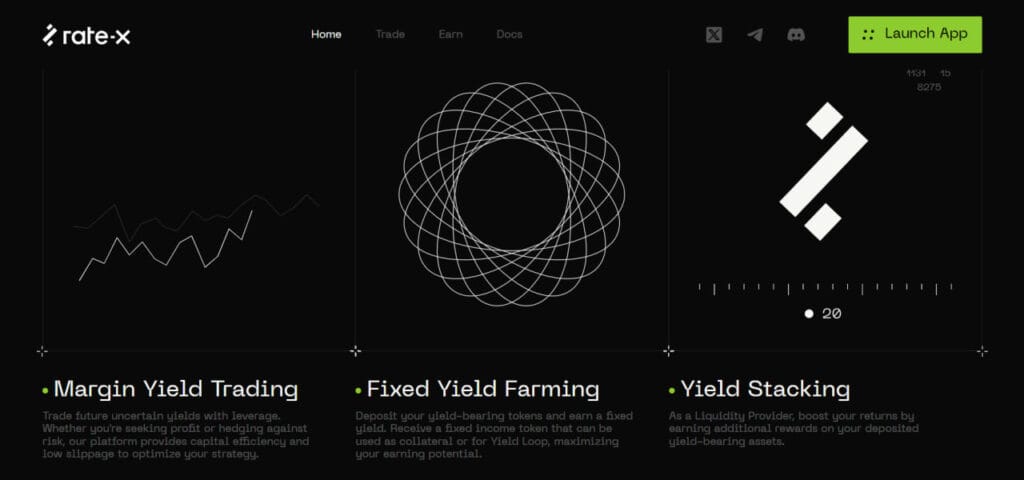
For many users, speculation isn’t the goal—certainty is. Earn Fixed replicates traditional fixed income.
By holding ST and shorting YT, you synthetically create PT. Over time, YT decays, leaving you with principal value plus the implied fixed return you locked at entry.
This is functionally similar to buying a zero-coupon bond: you buy it at a discount and redeem it at par later. The implied rate is your fixed yield. Rate-X shows a net APY (after management fee).
Earn Fixed differs from lending on Aave or Compound: there’s no floating rate; your APY is locked by market pricing at entry. Risks, however, include protocol malfunctions, underlying YBA shocks (slashing, depegs), or rare socialised losses.
Also Read: Top 5 RWA Coins to Buy Now
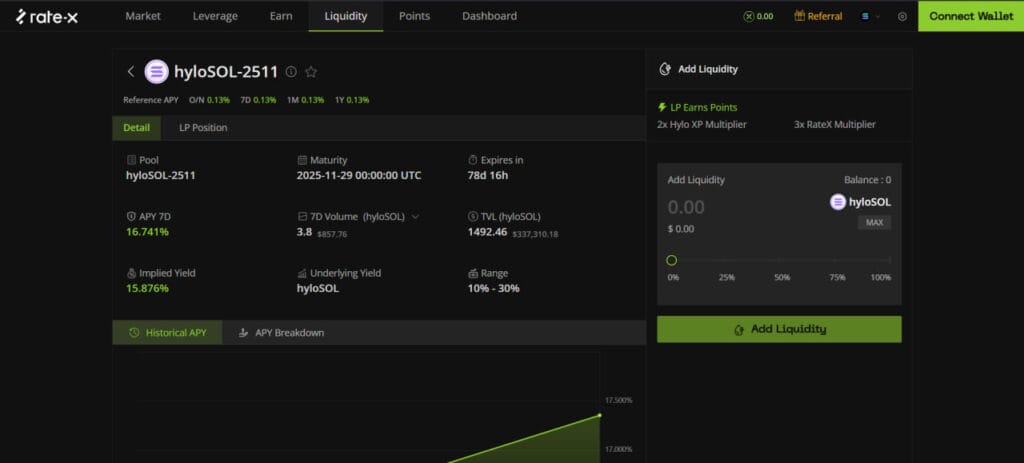
Liquidity Provision: The Beating Heart of Rate-X
LPs keep the system alive. Their journey:
- Deposit a YBA (say JitoSOL).
- Mint ST.
- Optionally mint YT up to the AR-cap.
- Provide ST/YT to the AMM, perhaps concentrating around expected ranges.
Rewards
- YBA yield via ST rebasing.
- Trading fees on swaps.
- Protocol rewards (potential points, fee rebates).
Risks
- Liquidity risk: exiting requires closing YT/ST balance; imbalance can make this costly.
- Impermanent Loss (IL): as YT decays, value shifts. Rate-X’s design softens IL as expiry nears, eliminating it at maturity.
- Socialized Loss: LPs are the final backstop if insurance and ADL fail. Rare, but real.
AR-Coefficient
This variable sets how much YT can be minted per ST (e.g., 2 YT per ST). It controls systemic exposure and differs by market depending on perceived stability.
Also Read: Top 4 Jito Streams Alternatives for Solana HFT
Fees and Protocol Revenue
Rate-X earns revenue via:
- Trading fees (e.g., 1%) are shared with LPs.
- Management fees on Earn Fixed (slice of ST’s rebasing yield).
- Yield fees (5% of position yield).
- Expiry fees on unclaimed balances after grace periods.
This mix funds operations, insurance, and incentives while compensating LPs.
Also Read: Top 5 Apps for DEX Trading: Master DeFi Like a Pro
Comparisons: Rate-X vs Pendle, Element, Spectra
| Feature | Rate-X | Pendle | Element | Spectra (APWine) |
|---|---|---|---|---|
| How YT is created | Users deposit yield-bearing assets and split them; YT float is limited to deposits. | Similar to Pendle, deposit-based splitting. | Similar to Pendle, deposit-based splitting. | Specialised AMM for PT/YT trading. |
| Leverage | Built-in margin trading; traders can long or short yield with leverage. | No native leverage; external leverage only. | No native leverage. | No native leverage. |
| Liquidity model | Hybrid AMM + DLOB with epoch rebalancing for time decay. | EVM chains, especially Ethereum and L2S; ETH-centric markets. | AMM design with fewer maturity-specific adjustments. | AMM focused on PT/YT swaps. |
| Chains | Primarily Solana (LSTs, LRTs, Solana LP tokens); legacy BNB Chain version. | EVM chains, especially Ethereum and L2s; ETH-centric markets. | EVM chains. | EVM chains. |
| User outcomes | Long/short yield with leverage; lock fixed yield via Earn Fixed; strong Solana focus. | Fix rates or speculate on yield; broadest EVM menu and liquidity depth. | Similar to Pendle but with narrower adoption. | Similar to Pendle; originally pioneered yield tokenization. |
Risk Management in Detail
- TWAP-based liquidation: ensures spikes don’t trigger unfair liquidations.
- Epoch updates: freeze trading, record rates, rebalance AMM, and roll forward.
- Loss waterfall: predictable: insurance → ADL → LPs.
- Audits: Beosin’s report showed responsiveness to findings.
Community
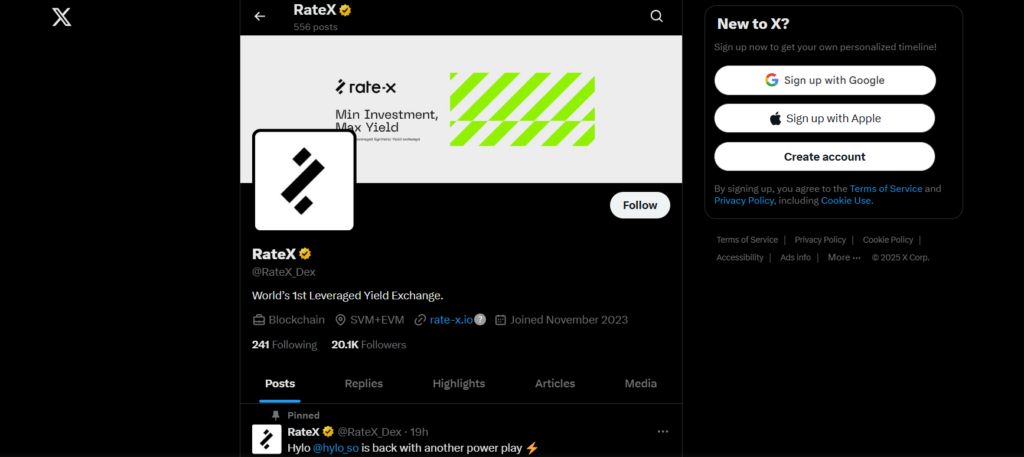
Rate-X shares fees with LPs, aligns Earn users with fixed APY, and attracts traders with leverage. Integrations with programs like Ethena delegation show awareness of the yield+points culture. Social updates (weekly yield rundowns) build transparency. As Solana’s ecosystem expands—especially restaking and LRTs—Rate-X positions itself as the rates venue.
Risks to Respect
Rate-X brings the innovation of tradable yield, but its risks demand attention. Smart contract flaws in liquidation, epochs, or fee logic remain possible despite audits. As YT approaches maturity, thinning liquidity may invite manipulation, even with TWAP and price cages. Underlying asset hazards—validator slashing, depegs, or unstable LP tokens—can directly impact outcomes. Systemic shocks could also overwhelm the insurance fund and auto-deleveraging, forcing rare but real socialised losses onto liquidity providers. For traders and LPs alike, understanding these structural risks is essential before engaging. Rate-X’s design is ambitious, but caution must balance opportunity in its markets.
Conclusion
Rate-X makes yield itself a financial primitive. By splitting yield-bearing assets into tradable components, enabling synthetic issuance, and layering leverage, AMMs, and order books, it lets DeFi users do what bond traders have done for centuries: trade interest rates. It serves three audiences—hedgers wanting certainty, speculators chasing rate views, and LPs seeking fees and yield. Risks remain: liquidity crunches, underlying asset failures, and systemic stress. But if Solana’s yield ecosystem keeps growing, Rate-X could emerge as the benchmark interest-rate exchange in DeFi, shaping how crypto learns to manage and price one of its most elusive variables: yield itself.
Frequently Asked Questions (FAQs)
How risky are smart contract bugs on Rate-X?
Smart contract flaws in liquidation, epochs, or fee logic remain possible despite audits. Rate-X has addressed known issues, but no audit guarantees absolute safety. Users should size positions with caution, recognising that complex leveraged systems always carry residual contract-level risks in DeFi.
Why does liquidity thin near YT maturity?
As Yield Tokens decay toward zero near expiry, liquidity often thins, spreads widen, and small trades can cause large price swings. Rate-X uses TWAP checks and price cages to reduce manipulation, but users should remain cautious when trading or exiting positions close to maturity.
What happens if the underlying yield-bearing asset fails?
Rate-X inherits all risks of the underlying yield-bearing asset. Slashing, stablecoin depegs, or faulty LP token mechanics directly affect Standard Tokens and Yield Tokens. Even Earn Fixed users remain exposed to tail events, since fixed returns don’t cancel fundamental asset risk, only rate volatility.
How does Rate-X protect users during systemic stress?
Rate-X employs a waterfall: insurance fund first, then auto-deleveraging of traders, and finally LPs. This structure absorbs routine shocks effectively, but in extreme crises, liquidity providers may face losses. Understanding this sequence is crucial, since systemic stress can overwhelm protections and impact participants unevenly.
Are socialised losses a real concern for LPs?
Socialised losses are rare but possible. If both insurance and auto-deleveraging fail, LPs act as the last backstop. While most days this risk is negligible, severe volatility can force LPs to cover deficits. They must weigh this tail exposure against the rewards of yield and fees.
