


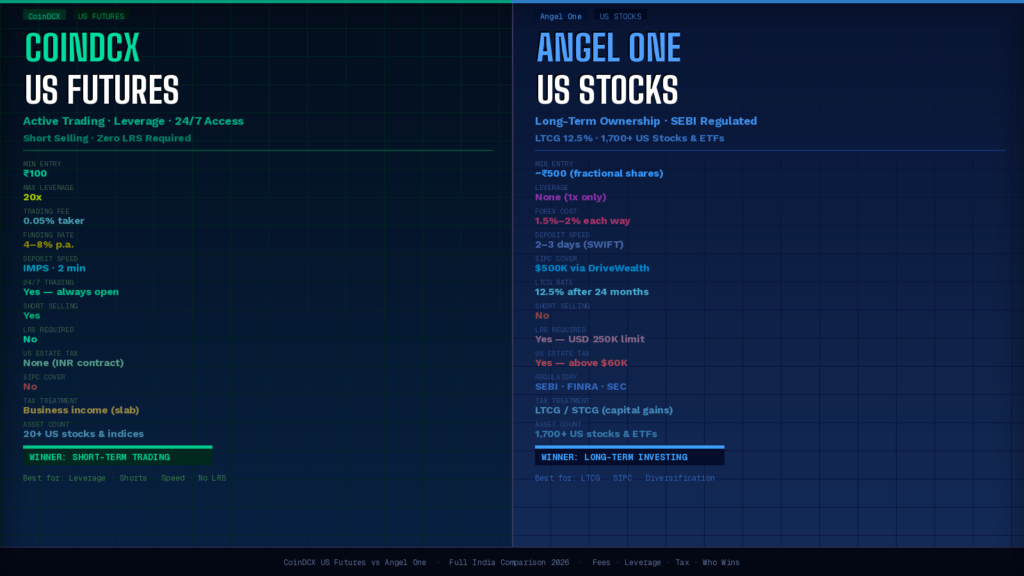
If you already have an Angel One demat account — and 27 million Indians do — the obvious question is whether you actually need another app to trade US stocks. Angel One added international investing in 2024 through its partnership with Vested Finance’s infrastructure, giving it access to US equities. CoinDCX went a different direction entirely, building INR-settled US stock futures that require no forex, no LRS paperwork, and no waiting three days for a SWIFT wire to clear.
These two platforms are not really competing for the same trader. Understanding where each wins — and where each falls short — will save you money, paperwork headaches, and a few sleepless nights if markets turn against you.

| Quick Answer: Angel One suits long-term investors who want actual US share ownership, SIPC protection, and LTCG tax treatment — all through an app they already use. CoinDCX wins for active traders who want leverage, short-selling, 24/7 access, and zero LRS paperwork. |
For on-demand analysis of any cryptocurrency, join our Telegram channel.
| Feature | CoinDCX US Futures | Angel One (US Stocks) |
| Product type | INR-settled perpetual futures | Direct US share ownership via LRS |
| Minimum investment | ₹100 | ~₹500–₹1,000 (fractional) |
| Leverage | Up to 20x | None (1x only) |
| Short selling | Yes | No |
| 24/7 trading | Yes | No — US hours only |
| US assets available | 20+ stocks & indices | 1,700+ stocks & ETFs |
| Deposit method | IMPS / NEFT | UPI / NEFT / bank transfer |
| Deposit currency | INR (no conversion) | INR converted to USD via LRS |
| Deposit speed | ~2 minutes | 2–3 business days (SWIFT) |
| LRS required | No | Yes |
| TCS on deposits | No | 20% TCS above ₹10L/year |
| Forex conversion fee | None | 1.5%–2% each way |
| Trading fee | 0.007%–0.05% of notional | ~0.25%–0.5% brokerage |
| Funding rate | 4–8% p.a. on open positions | Not applicable |
| Actual share ownership | No (contract only) | Yes |
| Dividends | No | Yes |
| SIPC protection | No | Yes — up to $500K |
| Withdrawal to bank | Same-day IMPS | $11 fee + 2–3 days |
| Demat integration | No | Yes — unified with Indian portfolio |
| US estate tax exposure | No (INR-settled) | Yes — 40% above $60,000 |
| Regulatory body | FIU-IN registered | SEBI regulated |
| Fractional shares | Yes (size in ₹) | Yes |
| Stock SIP / DCA | No | Yes |
| Tax treatment | Business income (slab rate) | LTCG / STCG (capital gains) |
| LTCG rate (24m+) | Not applicable | 12.5% |
| App quality | 7/10 | 8.5/10 |
| Portfolio tracking | Crypto + US Futures only | Full Indian + US unified |
| Onboarding time | 10 min (fresh KYC) | 5 min (existing Angel One user) |
Angel One getting into US investing is genuinely useful news for its 27 million existing users. Open the app, tap “US Stocks,” complete a short KYC top-up, and you can buy fractional Apple shares without downloading anything new. That convenience — plus SEBI’s familiar regulatory umbrella — is real.
But the product underneath is a direct ownership model. Your ₹5,000 gets converted to roughly $60 at current rates, travels via SWIFT to DriveWealth (Angel One’s US clearing partner), and sits in a custodial account in your name. You own a fraction of an Apple share. You get dividends. You have SIPC protection up to $500,000. Your cost basis is denominated in USD.

CoinDCX’s US Futures product is the mirror opposite. No share changes hands. No USD crosses a border. You open a perpetual futures contract on Apple’s price, denominated entirely in rupees. Your ₹5,000 stays in India. Your P&L arrives in your CoinDCX wallet in INR. The settlement never leaves the domestic financial system.
The fee structure is where the two platforms diverge most dramatically depending on how long you hold.

Angel One US investing fees
Currency conversion: 1.5%–2% each way (a round trip costs 3%–4% before a single trade is placed)
Brokerage: ~0.25% per transaction (may be zero in promotional periods)
Withdrawal fee: $11 flat per withdrawal back to your Indian bank
Ongoing holding cost: None — no daily charge for holding a position
CoinDCX US Futures fees
Trading fee: 0.007% (maker) to 0.05% (taker) of notional value — very low entry cost
Funding rate: 4%–8% per annum, charged three times daily on open positions
Deposit/withdrawal: Free via IMPS — no fee for moving INR
Run the numbers on a ₹10,000 trade in Apple shares held for different durations-
| Hold Duration | Angel One Cost | CoinDCX Cost (1x leverage) | Winner |
| 1 day | ₹320 (FX + brokerage) | ₹16 (1-day funding @ 6%) | CoinDCX |
| 1 week | ₹320 | ₹115 | CoinDCX |
| 3 weeks | ₹320 | ₹346 | Angel One |
| 1 month | ₹320 | ₹550 | Angel One |
| 3 months | ₹320 | ₹1,650 | Angel One |
| 12 months | ₹320 + tax | ₹6,600 + tax | Angel One |
The crossover point at 1x leverage is roughly 18–21 days. Below three weeks, CoinDCX’s funding rate hasn’t accumulated enough to exceed Angel One’s flat FX entry cost. Beyond three weeks, Angel One’s flat-rate model becomes dramatically cheaper for buy-and-hold. At 5x leverage the maths change: the notional funding cost is 5x larger, so the crossover happens in under 5 days.
Angel One offers no leverage on US stocks. What you deposit is what you trade. If Apple drops 10%, your position drops 10%. No amplification, no liquidation risk, but also no capital efficiency for traders who know what they’re doing.
CoinDCX goes up to 20x, though 3x–5x is the practical range most active traders use for individual stocks. At 5x leverage on a ₹5,000 deposit, you control a ₹25,000 notional Apple position. A 4% move in Apple becomes a 20% move on your P&L — genuinely powerful for short-term directional trades around earnings.
Short selling is where the gap is even larger. If you believe Tesla is overvalued, Angel One offers you no mechanism to profit from that view. You sit out or you sell a position you own. CoinDCX lets you open a short with one tap — same margin, same fees, same 24/7 access.
This comparison is not close. Angel One’s US investing feature, powered by DriveWealth’s infrastructure, gives Indian users access to 1,700+ US-listed stocks and ETFs. That means mid-caps, sector ETFs, REITs, dividend aristocrats, biotech, regional banks — the full US equity universe in one app.
CoinDCX currently lists around 20 US stocks and two indices (S&P 500 and NASDAQ 100 futures). The list covers the obvious names — Apple, NVIDIA, Tesla, Microsoft, Amazon, Alphabet, Meta, Palantir, AMD — but stops before anything outside mega-cap territory.
Angel One US investing uses the LRS route. Your rupees go through currency conversion, then travel internationally via SWIFT. Even with a smooth bank relationship, funds typically take 2–3 business days to settle in the US custodial account. During that window, you cannot trade.
CoinDCX’s deposit model is refreshingly simple. Open the app, tap “Add Funds,” send IMPS from your bank account. Funds arrive in roughly 2 minutes. You can be trading NVIDIA futures within 10 minutes of deciding to open an account.
Angel One
Angel One is SEBI-regulated — the gold standard for Indian brokers. Its US investing feature operates through DriveWealth, a US-registered broker-dealer subject to SEC and FINRA oversight. Your US holdings carry SIPC protection up to $500,000 in securities and $250,000 in cash. This is meaningful insurance that CoinDCX structurally cannot match.
The tradeoff: your assets live in two jurisdictions, adding US estate tax exposure. Non-US residents face a 40% estate tax on US-sited assets above $60,000. Angel One US holdings are US-sited. CoinDCX US Futures are INR-settled contracts — they are not US-sited assets.
CoinDCX
FIU-IN registered as a Virtual Asset Service Provider. ISO 27001:2022 certified. Cold storage for the majority of funds. Not SEBI-regulated, not SIPC-covered. The July 2025 security incident — a $44.2M operational wallet compromise with no user funds affected — showed both a vulnerability and a reasonably rapid response. Full details are covered in the linked safety article below.
For investors who need SEBI oversight and SIPC coverage, Angel One is the clear choice. For traders comfortable with crypto-adjacent regulation who want domestic INR settlement with no US jurisdictional exposure, CoinDCX is defensible.
This is where Angel One’s model genuinely shines for patient investors.
Angel One US stocks
Held under 24 months: STCG at your income slab rate
Held over 24 months: LTCG at 12.5% (updated Budget 2025-26)
Dividends: Taxed as income at slab rate in India, with potential foreign tax credit for US withholding tax
CoinDCX US Futures
All gains: Taxed as business income at your slab rate (20%–30% for most earners)
LTCG: Not available regardless of hold duration — futures income is always business income
Loss offset: Losses can be set off against other business income (not capital gains)
| Concrete Tax Example ₹5 lakh profit after 2+ years via Angel One US stocks = ₹62,500 tax (12.5% LTCG) ₹5 lakh profit via CoinDCX US Futures = ₹1,50,000 tax (assuming 30% slab) Difference: ₹87,500 more tax on the same ₹5 lakh gain via CoinDCX |
Angel One’s main app is a mature, well-designed product built over years for India’s retail investing market. Portfolio tracking, watchlists, research reports, options chain, IPO applications, MF investments, and now US stocks — all in one dashboard. The US investing section is cleanly integrated. It doesn’t feel bolted on.
CoinDCX’s app is functional and has improved substantially since 2023, but it’s primarily a crypto exchange that added US Futures. The onboarding for US Futures specifically requires navigating to a somewhat buried section. Charting tools are basic compared to dedicated trading apps. The mobile experience (7/10) is workable but not polished.
If you’re a complete beginner, Angel One’s polish matters. If you’re already comfortable on trading apps and just want execution speed and leverage, CoinDCX’s interface is perfectly adequate.
The most sophisticated Indian traders aren’t choosing between these two — they’re using both.

Angel One for
Core long-term allocation: Apple, MSFT, S&P 500 ETF — any position you plan to hold 24+ months for LTCG treatment
Dividend stocks: Companies where actual share ownership and dividend income matter
Breadth: Anything outside CoinDCX’s 20-stock list
CoinDCX for
Short-term directional trades: Earnings, Fed decisions, macro events where 24/7 access and speed matter
Hedging: Go short on CoinDCX to hedge an Angel One long during uncertain periods
Leveraged plays: High-conviction trades with defined stop-losses where 1x exposure isn’t enough
Weekend / after-hours exposure: When US markets are closed but something just happened in the news
| Scenario 1: The existing Angel One F&O trader Rahul, 32, uses Angel One for Indian F&O and wants US exposure. He adds the US stocks feature in 10 minutes because his KYC is already done. He sets up a ₹3,000/month SIP into an S&P 500 ETF. Two years later, his gains qualify for 12.5% LTCG. He never needed a second account. Verdict: Angel One |
| Scenario 2: The NVIDIA earnings trader Priya, 28, wants to go long NVIDIA before their quarterly earnings and exit within 48 hours. She needs 3x leverage to make the risk/reward worthwhile on ₹8,000 margin. She needs to enter tonight, not after a 3-day SWIFT transfer. She opens a CoinDCX position at 10 PM IST on a Sunday — something Angel One US investing cannot do. Verdict: CoinDCX |
| Scenario 3: The Tesla bear Ankit follows Elon Musk’s social media activity and believes Tesla is overvalued heading into a product announcement. He wants to short TSLA for 2 weeks. Angel One offers no mechanism for this. CoinDCX lets him open a short with ₹5,000 margin. His thesis plays out, TSLA drops 8%, he closes profitably. Verdict: CoinDCX — Angel One cannot execute this trade at all |
| Scenario 4: The diversified US portfolio builder Meera, 45, wants genuine US equity diversification: dividend stocks (J&J, Coca-Cola), sector ETFs (healthcare, utilities), and a couple of growth names. She wants SIPC protection, actual share ownership, and LTCG treatment. Her holding horizon is 5–10 years. CoinDCX’s 20 stocks cannot meet this need. Verdict: Angel One |
| Your situation | Recommended |
| Already have Angel One account | Angel One US Stocks |
| Want leverage on US stocks | CoinDCX |
| Want short-selling | CoinDCX |
| Trading earnings / macro events | CoinDCX |
| Holding 24+ months for LTCG | Angel One |
| Need SIPC insurance | Angel One |
| Stocks outside CoinDCX’s 20 names | Angel One |
| Want to avoid LRS / TCS | CoinDCX |
| Trading weekends / after hours | CoinDCX |
| Active F&O trader wanting US too | CoinDCX (familiar leverage mechanics) |
| Long-term wealth building, tax-efficient | Angel One |
| Tight capital, need leverage to size up | CoinDCX |
| Want dividends from US holdings | Angel One |
| Concerned about US estate tax | CoinDCX (not US-sited) |
Can I use both Angel One and CoinDCX for US stocks at the same time?
Yes, and many traders do. Your CoinDCX deposits are domestic INR transfers with no LRS implication, so they don’t count toward your USD 250,000 annual LRS limit. Angel One US investing uses LRS. Running both simultaneously is completely legal, and using CoinDCX for short-term trades while building a long-term Angel One portfolio is a rational split strategy.
Does Angel One US investing use the same demat account as my Indian stocks?
Your Angel One demat holds your Indian securities (NSDL/CDSL). US stock holdings through Angel One sit in a custodial account with DriveWealth in the US — legally separate from your demat. They appear unified in the Angel One app dashboard, but the underlying structure is different. Your US holdings are not covered by Indian deposit insurance.
Angel One shows a ‘0% brokerage’ offer on US stocks. Is it actually free?
The brokerage itself may be zero or near-zero during promotional periods, but the 1.5%–2% forex markup on currency conversion is unavoidable. On a ₹10,000 deposit, expect ₹150–₹200 lost immediately to conversion. On exit, the reverse conversion happens again. The round-trip forex cost is typically 3%–4% regardless of brokerage headline rates — this is the real entry and exit cost to factor in.
CoinDCX US Futures are available 24/7 — does that include Indian holidays?
Yes. Because the underlying is a perpetual futures contract settled in INR, it operates on CoinDCX’s exchange infrastructure rather than US market opening hours. You can trade Apple futures at 4 AM on a Saturday in India. Liquidity is thinner outside normal US trading hours (7:30 PM–2 AM IST), so bid-ask spreads may widen slightly.
What happens to my Angel One US stocks if Angel One or DriveWealth shuts down?
Your shares are held in a custodial account in your name with DriveWealth, covered by SIPC up to $500,000 in securities. If DriveWealth faced insolvency, SIPC would facilitate transfer of your assets to another SIPC-member broker. This protection covers broker failure — not market losses. Angel One shutting down independently would not affect your DriveWealth custodial holdings.
How does the funding rate affect my trade if I’m wrong about direction?
If your position moves against you, you’re losing on two fronts simultaneously: the mark-to-market loss on the contract plus the ongoing funding cost accumulating three times daily. On a 5x leveraged long that’s dropped 8%, you’ve lost 40% of your margin — and the funding clock keeps running. This is why stop-losses on CoinDCX US Futures aren’t optional discipline; they’re financial self-preservation.
Which platform is better for someone completely new to US investing?
Angel One, without question. The familiar interface, SEBI regulation, SIPC coverage, actual share ownership, and zero liquidation risk make it appropriate for someone starting US equity exposure for the first time. CoinDCX’s perpetual futures mechanics — funding rates, leverage management, liquidation prices — require some understanding of derivatives before going in.
I have ₹50,000 to allocate to US stocks. How should I split it?
One approach that many active investors use: put ₹35,000 into Angel One US stocks as a core long-term hold targeting LTCG treatment after 24 months, and keep ₹15,000 in CoinDCX for short-term opportunities around earnings or macro events. This gives you long-side ownership with tax efficiency plus active trading flexibility without betting everything on leverage.
Further Reading
For on-demand analysis of any cryptocurrency, join our Telegram channel.
