


Crypto signals are one of those things the market loves to oversell. On one side, they get packaged like instant-profit cheat codes.
On the other, critics treat them like a crutch for traders who do not want to think. Both takes miss the point.
A crypto signal is not a magic button. It is a structured trade idea. It helps a trader identify a possible opportunity, define risk, and act with more clarity.
In a market that moves 24/7, where Bitcoin can rip, altcoins can overreact, and sentiment can flip in a single candle, that kind of structure matters.
That is why traders look at services like CoinCodeCap Signals. Not because signals remove uncertainty, but because they reduce noise. Instead of staring at ten charts, five X threads, three Telegram channels, and one bad decision waiting to happen, a trader gets a focused setup with defined conditions.

Used properly, signals save time, improve discipline, and make execution more systematic. Used badly, they become another way to gamble with extra steps. The difference is never just the signal itself.
The difference is the analysis behind it, the delivery speed, the clarity of the setup, and the trader’s ability to follow a plan without turning one alert into a full-blown emotional spiral.
This article breaks down what crypto signals are, what they usually include, how they work, the main types you will encounter, and where traders normally receive them.
Think of it as removing the fog from one of the most hyped tools in crypto trading.
- Crypto signals are structured trade alerts, not guaranteed profits.
- They tell traders what to buy or sell and where.
- A strong signal includes entry, stop loss, and take profit.
- Signals can come from analysts, algorithms, or hybrid systems.
- They exist across free, paid, spot, futures, short-term, and swing formats.
- Telegram is popular, but signals also arrive through apps, dashboards, and email.
- Good signals improve trading structure and reduce random decision-making.
- Signals work best when paired with discipline and risk management.
| Product Name | Key Features | Product Link |
| C3 Signals | Real-time crypto alerts, clear entry zones, take-profit structure, stop-loss guidance, user-friendly delivery | Click here! |
| AltSignals | Telegram-based access, broad market coverage, trading alerts, beginner-friendly format, signal-focused workflow | Click here! |
| Learn 2 Trade | Telegram trade ideas, educational support, structured entries, beginner accessibility, regular market updates | Click here! |
What Are Crypto Signals & How Do They Work?
Crypto trading is a fast game pretending to be an easy one.
From the outside, signals look simple. Someone tells you which coin to trade, where to enter, where to exit, and where to cut risk.
Done. Clean. Efficient. That promise is exactly why crypto signals have become such a big part of the trading ecosystem. They offer speed, clarity, and the feeling that someone has already done the hard work.
That appeal is real. Most traders do not fail because they cannot open a chart. They fail because they drown in information.
Too many indicators. Too many opinions. Too many false breakouts. Too many emotional entries after price already moved. Signals help by narrowing the field. They turn endless market noise into an actionable setup.
But this is where the market likes to play games with people’s expectations.
Signals can help identify trade opportunities, but they are not shortcuts to profit. They do not override volatility.
They do not protect traders from poor position sizing. They do not fix late entries, revenge trades, or overleveraged futures positions. A great signal can still fail. A weak trader can still mismanage a strong setup.
The right way to understand signals is this: they are decision-support tools. They help traders operate with more structure in a market built on speed and uncertainty. That is why platforms like C3 Signals matter.
They are useful not because they eliminate risk, but because they help traders approach risk with more discipline.
Good signals do not promise fantasy. They define probability. They say, here is the setup, here is the invalidation, here are the targets, now execute like a professional instead of a panic-driven candle chaser.
What Are Crypto Signals?
Crypto signals are trade ideas or alerts that tell a trader what opportunity may be worth taking in the market.
In simple terms, a signal answers the most important trading questions before the trader has to guess:
- Which coin or trading pair to focus on
- Whether the setup is a buy or sell
- Where to enter the position
- Where to take profit
- Where to place the stop loss
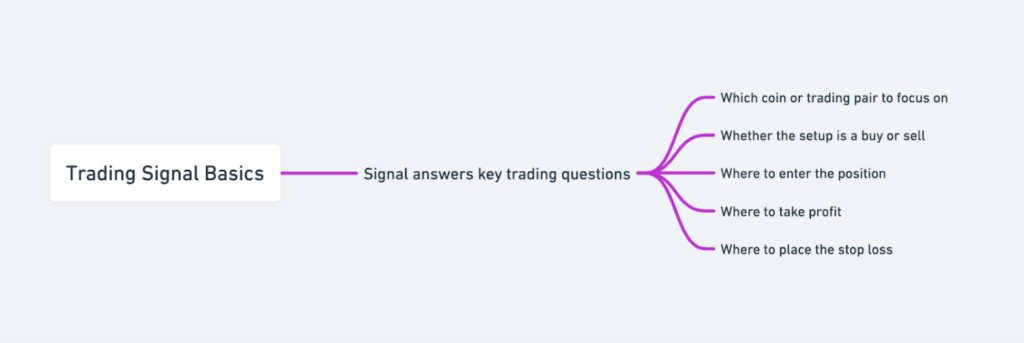
That is the core of it. A signal is not just “buy BTC” or “ETH looks bullish.” That is noise dressed as confidence. A real signal has structure. It gives a trader a plan.
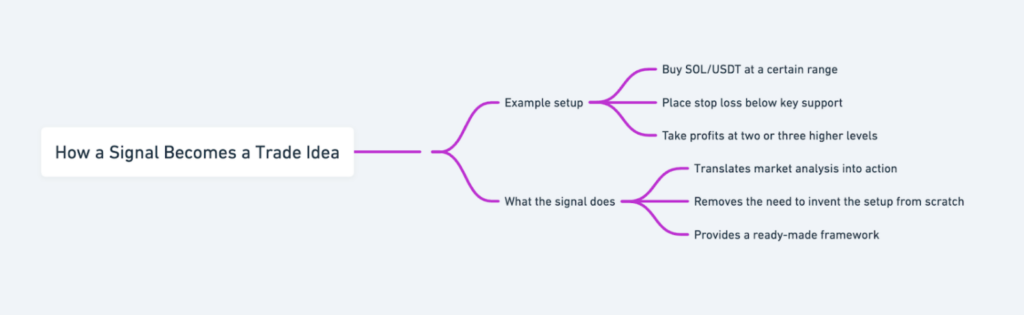
For example, if a signal says to buy SOL/USDT at a certain range, place a stop loss below a key support level, and take profits at two or three higher levels, it is translating market analysis into an executable trade idea. The trader no longer has to invent the setup from scratch. The framework is already there.
This matters because crypto markets are messy. Prices move quickly, liquidity shifts, sentiment swings, and narratives rotate with almost no warning. A trader trying to process all of that in real time can easily freeze, chase, or enter with no defined risk. Signals exist to simplify that process.
At their best, crypto signals act like compressed market analysis. They take chart structure, momentum, volume, trend conditions, and sometimes broader catalysts, then package those elements into a format a trader can act on quickly.
That does not mean every signal is high quality. Some are vague. Some are late. Some are just recycled hype with a stop loss pasted on top. But the real purpose of a crypto signal is straightforward: convert analysis into a trade plan.
What Does a Crypto Signal Usually Include?
A proper crypto signal is not one sentence long. It is a compact trade framework. Every useful signal should contain enough information for a trader to understand both the opportunity and the risk.
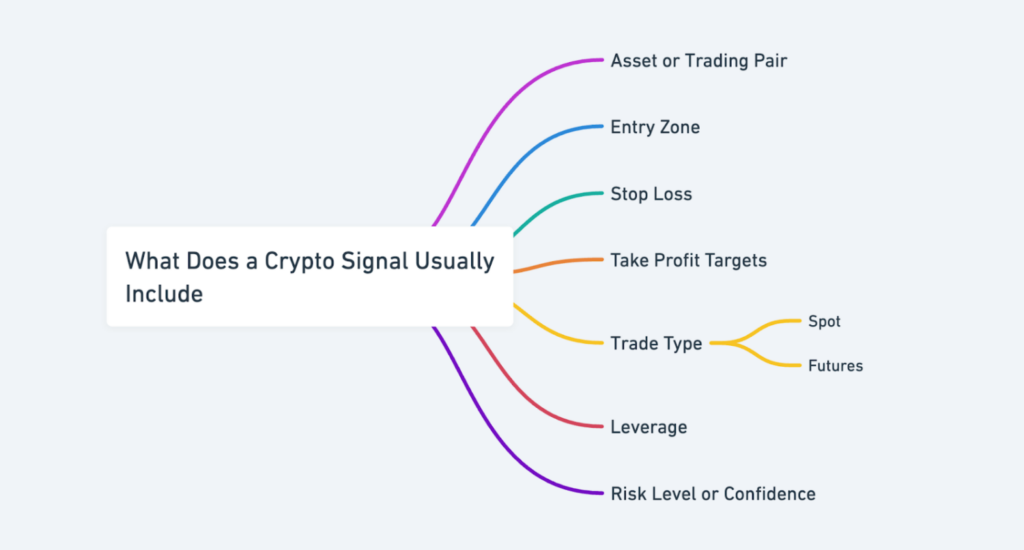
Asset or Trading Pair
This is the market being traded, such as BTC/USDT, ETH/USDT, or SOL/USDT.
This sounds basic, but it matters more than people think. The pair tells you what market structure, volatility profile, and liquidity environment you are entering. Trading BTC is not the same as trading a small-cap altcoin. One moves with relative depth and macro sensitivity. The other can behave like it drank three energy drinks and discovered leverage.
Entry Zone
The entry zone tells the trader where the position should be opened.
Sometimes it is a single price. More often, it is a range. That range matters because markets do not always tap one perfect number. They move through zones. A good signal reflects that reality and gives traders an acceptable execution area rather than forcing unrealistic precision.
Stop Loss
The stop loss is the invalidation point.
This is where the signal admits the setup is no longer working. That is why it is one of the most important parts of the entire trade. Without a stop loss, a signal is not structured. It is just hope with formatting.
A strong signal does not place a stop randomly. It places it where the original trade idea would logically be broken, such as below support, above resistance, or beyond a key structural level.
Take Profit Targets
Take profit levels define where profits may be locked in if the market moves in the expected direction.
Most signals include multiple targets rather than one final exit. That allows traders to scale out, secure gains gradually, and reduce risk as the trade develops. It also reflects a smarter reality: markets often move in steps, not straight lines.
Trade Type – Spot or Futures
A signal should make it clear whether the trade is meant for spot or futures.
This distinction matters because the risk profile changes dramatically. Spot positions involve owning the asset and usually carry less immediate liquidation risk. Futures positions introduce leverage, funding considerations, and much tighter consequences for bad execution.
If a signal does not clearly specify whether it is for spot or futures, that is already a quality red flag.
Leverage, If Applicable
If the trade is a futures setup, leverage guidance may be included.
This could be something like 3x, 5x, or low leverage only. Good providers understand that leverage is not just a multiplier for profit. It is a multiplier for mistakes. If leverage is suggested at all, it should be aligned with the volatility of the asset and the structure of the trade.
Risk Level or Confidence
Some signals include a risk rating or a confidence score.
This helps traders understand how aggressive or conservative the setup is supposed to be. A high-confidence label does not guarantee success, but it may indicate stronger alignment across trend, momentum, support or resistance, and timing. A higher-risk setup may involve thinner liquidity, more volatility, or a less developed chart pattern.
This part is especially useful because not all signals deserve the same capital allocation. Traders who treat every alert like equal quality usually learn that lesson the expensive way.
How Do Crypto Signals Work?
Crypto signals work by turning market analysis into a structured alert that traders can act on. The workflow is simple on the surface, but the quality of each step is what separates disciplined signal services from random market shouting.
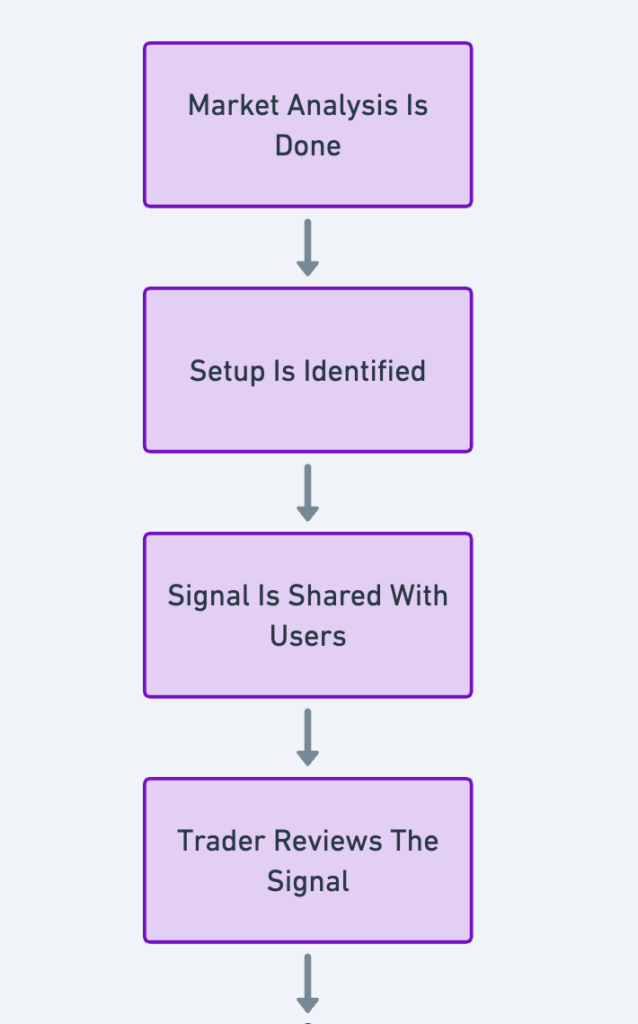
Market analysis is done
Everything starts here.
Before a signal is shared, someone or something studies the market. That analysis may include price structure, support and resistance, trend direction, momentum, liquidity conditions, volatility, volume, and sometimes broader macro or sentiment context.
This step is the engine room. If the analysis is weak, the signal is weak. No formatting trick can save a bad read on the market.
A setup is identified
Once analysis is complete, a potential trade opportunity is selected.
This setup might be a breakout above resistance, a retest of support, a trend continuation move, a reversal pattern, or a momentum entry after confirmation. The key is that the signal is not based on random excitement. It is based on a specific thesis.
That thesis should answer one simple question: why does this trade make sense right now?
The signal is shared with users
After the setup is defined, it is sent to traders through the provider’s chosen delivery channel.
The speed and clarity of this step matter a lot. In crypto, a delayed signal can go from useful to useless quickly. A strong provider shares the alert in a format that is easy to understand and easy to execute without confusion.
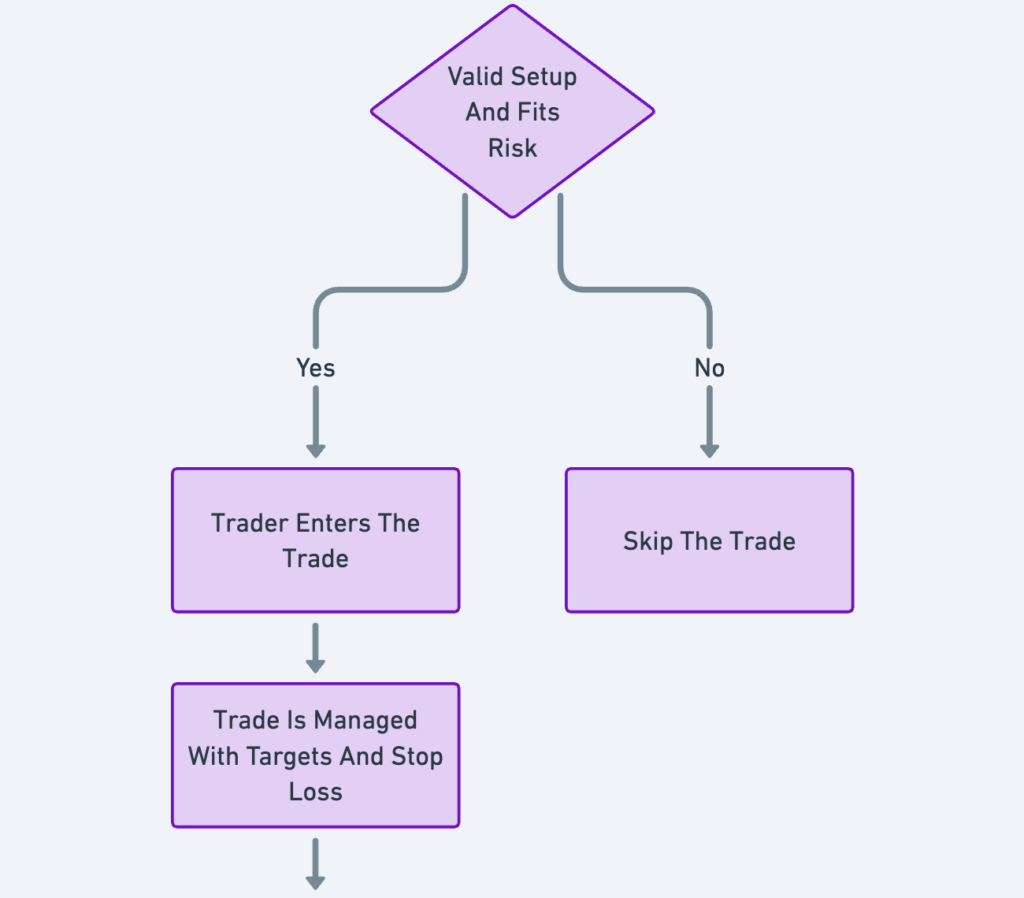
The trader enters the trade
Once the signal is received, the trader decides whether to act on it.
This part often gets ignored, but it matters. A signal is not a forced trade. It is an opportunity. The trader still needs to check whether price is still within the entry zone, whether the setup remains valid, and whether the trade fits their own risk tolerance.
Good traders do not blindly click because a signal appeared. They verify conditions first.
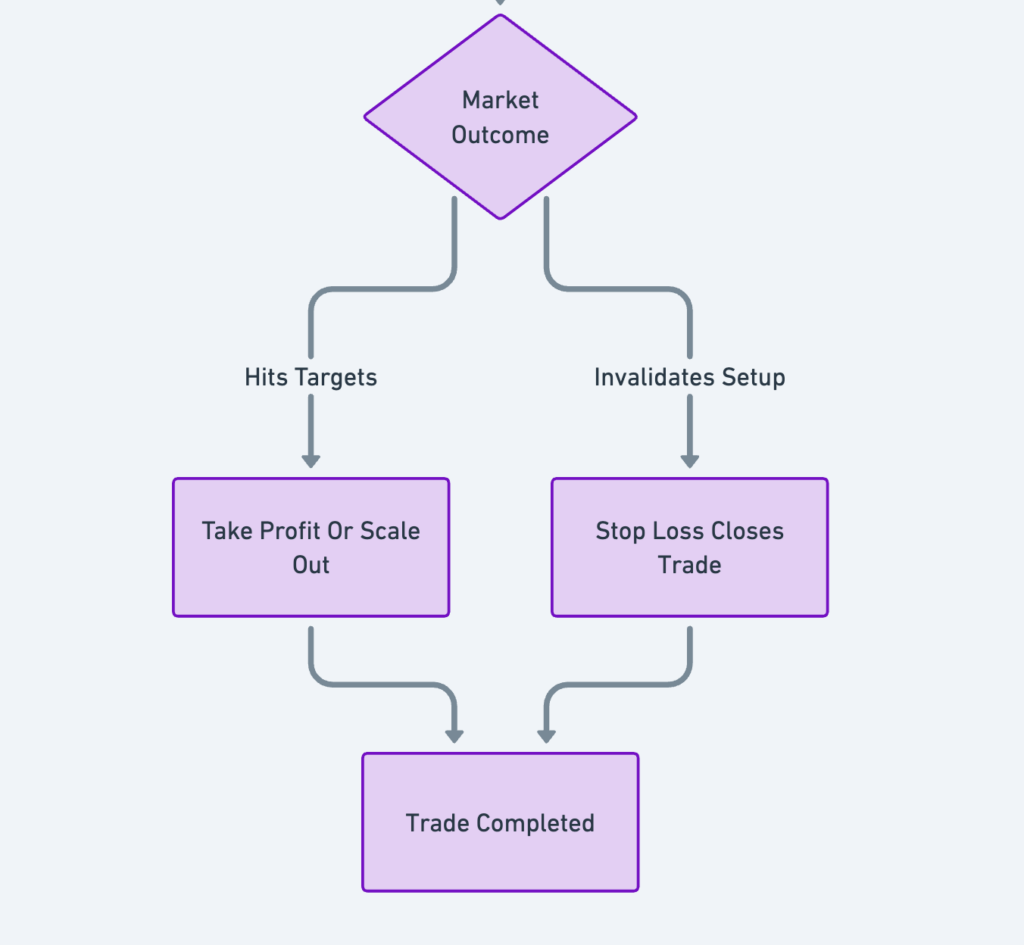
The trade is managed using targets and stop loss
After entry, the trade is managed according to the plan.
If price moves toward the take-profit levels, the trader may scale out or move stop loss to reduce risk. If the market invalidates the setup, the stop loss closes the trade. That is how signals are supposed to work. The structure is there to avoid improvising under pressure.
This is where discipline shows up. The market does not usually destroy traders in the setup phase. It destroys them in the management phase. Entering late, moving stops, ignoring exits, and chasing extra profit are how clean signals turn into dirty outcomes.
At a mechanical level, that is how crypto signals work. Analysis creates the setup. The setup becomes the alert. The alert becomes the execution plan. What happens next depends on both market conditions and the trader’s ability to follow the structure instead of fighting it.
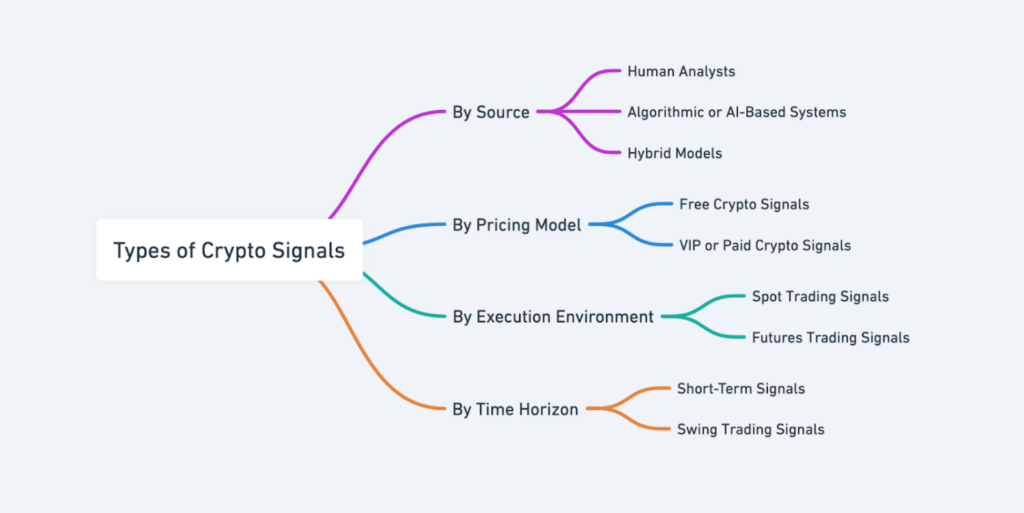
Types of Crypto Signals
Not all crypto signals are built the same. They differ by source, pricing model, trade style, time horizon, and execution environment. Understanding these categories matters because the best signal type depends on what kind of trader you actually are, not what kind of trader your ego thinks you are.
Human Analysts
These signals are created by experienced traders or research teams.
Human-generated signals usually rely on chart reading, price action, trend analysis, support and resistance, market context, and discretionary judgment. Their strength is flexibility. Humans can interpret nuance, changing sentiment, and unusual conditions that may not fit a rigid model.
The weakness is consistency. Human analysts can be brilliant, but they can also be biased, late, overconfident, or emotionally influenced.
Algorithmic or AI-Based Systems
These signals are generated by systems, models, bots, or rule-based logic.
Their strength is speed, repeatability, and emotion-free execution. A system can scan multiple markets continuously and trigger setups based on fixed conditions. In fast markets, that efficiency can be valuable.
The weakness is rigidity. Algorithms are only as strong as the logic behind them. If market behavior changes or the model is poorly designed, the signal quality can drop fast.
Hybrid Models
This is where things often get more interesting.
Hybrid systems combine machine-based scanning with human review. An algorithm may identify potential setups, then an analyst filters, validates, or refines them before they are sent out. This model tries to capture the speed of automation and the judgment of human oversight.
In theory, this is one of the strongest approaches because it reduces noise while keeping context. In practice, execution quality still depends on the provider.
Free Crypto Signals
Free signals are publicly available and often used as entry-level content.
They are good for testing a provider’s style, quality, and clarity before paying. They also help beginners understand how signals are structured. But free signals tend to be less detailed, less frequent, or delayed compared with premium versions.
They are useful for sampling, not always for building a full trading process.
VIP or Paid Crypto Signals
Paid signals usually offer more depth, faster delivery, and a more structured service.
This can include more frequent alerts, detailed setups, ongoing trade updates, educational support, or broader market coverage. The idea is that the paying user gets better operational value, not just more messages.
Of course, paid does not automatically mean good. A bad provider with a subscription page is still a bad provider. But the strongest services usually reserve their best workflow for premium users.
Spot Trading Signals
Spot signals are designed for buying and selling actual crypto assets without leverage.
These are often better suited to traders who want a more measured risk profile. Spot setups typically tolerate more room, fewer liquidation concerns, and a calmer execution environment compared with futures.
They are not risk-free. Crypto can still collapse dramatically. But the structure is usually less aggressive.
Futures Trading Signals
Futures signals are built for leveraged trading.
These are more aggressive and usually move faster. They require tighter execution, better discipline, and a stronger understanding of liquidation risk, leverage sizing, and volatility. A clean futures signal can produce outsized gains. A sloppy one can torch capital fast.
This is where signal quality and trader discipline matter most.
Short-Term Signals
These focus on quick moves over shorter time frames.
They may target intraday breakouts, momentum bursts, or short-lived technical setups. The advantage is speed and frequent opportunity. The downside is that execution becomes much more sensitive. Late entries and slow reactions hurt more here.
Short-term signals suit active traders, not passive observers.
Swing Trading Signals
Swing signals target moves that may play out over days or even weeks.
These are typically less frantic and more structure-driven. They often rely on broader trend conditions, larger support and resistance zones, and a more patient approach to profit targets. Swing signals can fit traders who do not want to babysit every candle but still want active exposure.
For many users, this is a more sustainable signal category than trying to scalp every twitch in the market.
Where Are Crypto Signals Shared?
A signal is only useful if it reaches the trader clearly and on time. Delivery matters more than people admit. A strong setup sent in a messy format or with poor timing can lose most of its value. That is why the delivery channel is not just a convenience issue. It is part of the product.
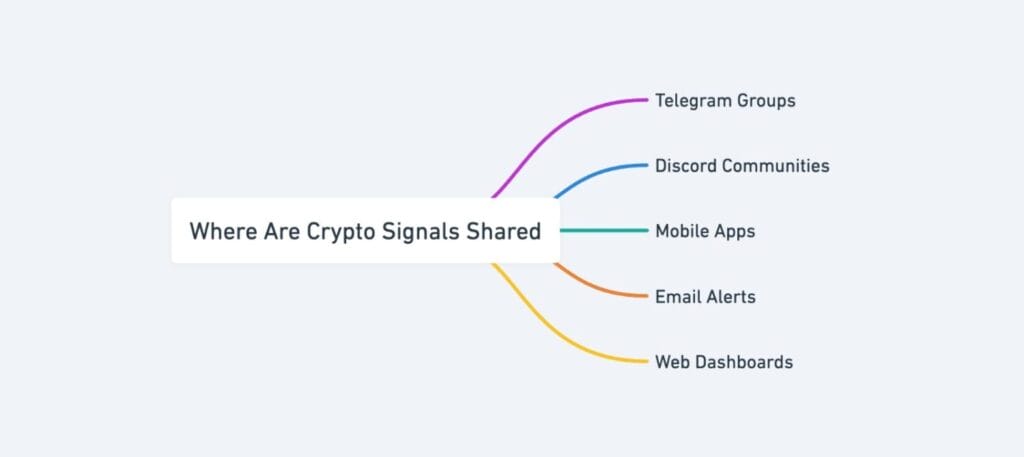
Telegram Groups
Telegram is the dominant home of crypto signals for a reason.
It is fast, direct, mobile-friendly, and built for alert-based communication. Traders can receive signals instantly, track updates in real time, and stay connected to ongoing market commentary. This is one reason services like C3 Signals work well in this format. The market moves fast, and Telegram matches that speed.
That said, Telegram quality varies wildly. Some channels are clean and structured. Others feel like pure noise with extra caps lock. The platform itself is useful. The discipline of the provider is what determines whether it becomes signal delivery or chaos delivery.
Discord Communities
Discord is common among trading communities that want more than just alerts.
It supports channels for different asset classes, discussion threads, education, community interaction, and trade updates. This makes it useful for providers that combine signals with trader discussion, mentoring, or broader research.
The strength of Discord is depth. The weakness is clutter. Without strong organization, important alerts can get buried inside constant chatter.
Mobile Apps
Some providers deliver signals through dedicated mobile apps.
This can offer a cleaner experience, with push notifications, trade tracking, watchlists, and structured dashboards in one place. Apps are useful when a provider wants more control over the user experience instead of relying on third-party communication platforms.
The tradeoff is adoption. Traders already live on Telegram and exchange apps, so a dedicated app has to be genuinely useful to earn attention.
Email Alerts
Email is less dominant in fast crypto trading, but it still has value.
It works better for swing traders, premium summaries, daily setups, and educational breakdowns rather than urgent intraday alerts. Email gives more room for explanation and structure, but it is not ideal for fast execution in volatile conditions.
If the signal depends on immediate reaction, email is usually too slow for primary delivery.
Web Dashboards
Web dashboards give traders a centralized place to review signals, updates, performance, and broader market context.
This format works well for users who want more than one-off alerts. A dashboard can help organize active trades, historical setups, analytics, and research in a much more structured way. It is especially useful for traders who want visibility, not just notifications.
The best providers often combine channels. Telegram for speed. Dashboard for structure. App for portability. Email for summaries. The channel mix depends on the type of trader being served.
That is the first half of the picture. Up to this point, we have defined what crypto signals are, what they include, how they work, what forms they take, and where they are delivered. In the second half, the bigger questions start showing up: what analysis actually powers them, what benefits they offer, where they fail, how to choose a reliable provider, and when signals beat doing everything alone.
What Analysis Is Used Behind Crypto Signals?
A crypto signal is only as good as the analysis behind it. This is the part most traders ignore when they judge signal quality. They look at the alert, the entry, maybe the target, and ask whether it won or lost. Fair enough. But that only measures the outcome. It does not measure the process. In trading, process quality matters because outcomes can lie in the short term.
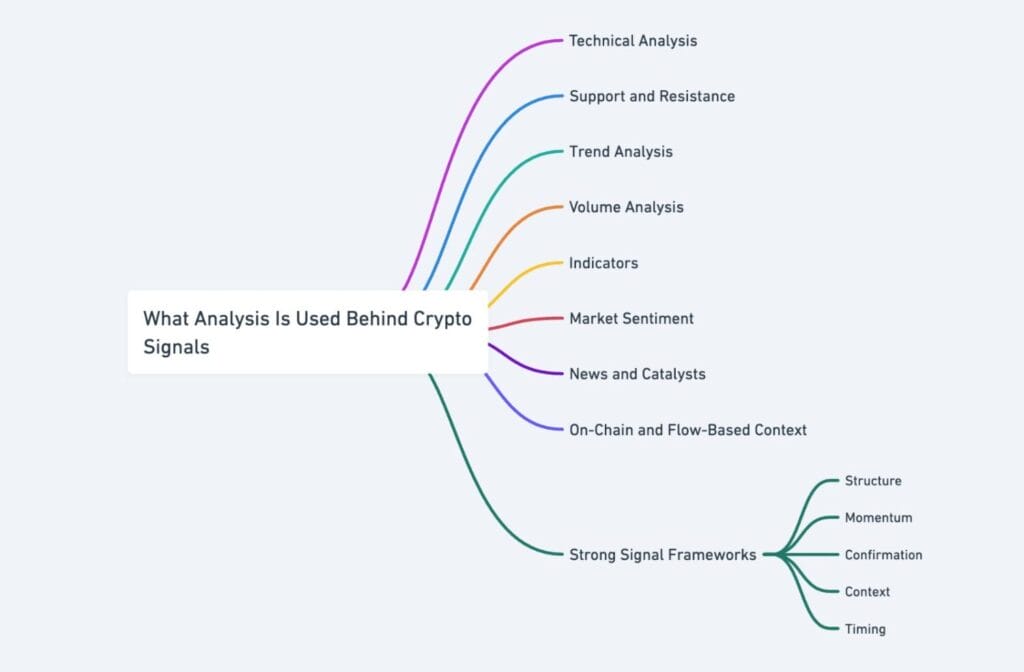
Serious signal providers do not pull setups out of thin air. They rely on one or more analytical frameworks to identify probability, timing, and risk. The best providers combine multiple layers instead of depending on one indicator and a dream.
Technical Analysis
This is the foundation behind most crypto signals.
Technical analysis studies price behavior on the chart. It looks at how price has moved, where it is reacting, and whether the current structure suggests continuation, reversal, or breakdown. This includes trendlines, support and resistance zones, breakout structures, consolidation ranges, candlestick behavior, and broader market positioning.
The reason technical analysis dominates signal creation is simple. Price is the final output of all market opinions. Every narrative, panic, accumulation phase, and liquidity event eventually shows up on the chart.
Support and Resistance
This is one of the most practical tools behind signal generation.
Support is the zone where buying interest may step in. Resistance is the zone where selling pressure may appear. A signal provider studies these levels to decide where price may bounce, reject, or break through.
This matters because signals need structure. Entry zones often sit near support in long setups or near resistance in short setups. Stop losses are usually placed beyond these levels. Take-profit targets often align with the next key zone on the chart.
If support and resistance are mapped badly, the entire signal becomes weaker.
Trend Analysis
Trend determines the environment in which the signal exists.
A setup in a strong uptrend behaves differently from a setup in a sideways market. A breakout during high momentum is not the same as a breakout attempt in a weak trend with poor volume. Good signals pay attention to the larger market direction before focusing on the entry itself.
This is one reason many weak signals fail. They may look technically clean on a small timeframe, but they are moving against the broader trend. That is like trying to win a footrace while running uphill in wet shoes.
Volume Analysis
Price movement without volume is suspicious. Volume confirms participation.
Signal providers use volume to judge whether a breakout is real, whether a move has strength, and whether buyers or sellers are actually backing the price action. If price pushes through a key level on thin participation, the move may lack conviction. If the breakout happens with strong volume, the probability of follow-through can improve.
Volume analysis is especially useful in crypto because fakeouts are common. The market loves pretending it has conviction right before pulling the rug on weak hands.
Indicators
Indicators are common tools in signal building, but the way they are used matters.
Some providers rely on indicators like RSI, MACD, moving averages, Bollinger Bands, or stochastic oscillators to identify momentum, trend confirmation, overbought or oversold conditions, and possible reversals.
Indicators can be helpful, but they are not magic. A strong provider uses them as supporting tools, not as substitutes for market structure. If a signal is based on one indicator crossing another with no attention to chart context, that is not robust analysis. That is decorative confidence.
Market Sentiment
Crypto does not trade on charts alone. It trades on psychology.
Signal providers often pay attention to sentiment, especially in fast-moving conditions. Sentiment can come from broad market fear, excessive bullishness, social buzz, funding imbalances, liquidations, or narrative momentum. When traders get too greedy or too fearful, the market often responds violently.
A good signal provider watches sentiment because emotional extremes can create either opportunity or danger. Sometimes a perfect-looking setup fails because the crowd is already too one-sided.
News and Catalysts
Not all signals are purely technical.
Major news events can move crypto markets quickly. Exchange listings, macroeconomic announcements, ETF developments, project updates, legal decisions, token unlocks, ecosystem launches, security incidents, and regulatory headlines can all affect price behavior.
A sharp provider does not ignore this. Even if the signal is technically sound, upcoming news can change volatility conditions and invalidate a setup faster than any indicator can react.
On-Chain and Flow-Based Context
This layer matters more for advanced providers.
Some signals may be influenced by wallet activity, exchange inflows and outflows, whale behavior, network participation, stablecoin movement, or broader capital rotation across the market. This kind of analysis is not always necessary for every trade, but it can improve context and conviction, especially in larger trend-based setups.
The strongest signal frameworks do not worship one method. They combine structure, momentum, confirmation, context, and timing. That is the difference between a real trading process and a signal that looks polished but is built on thin logic.
Benefits of Crypto Signals
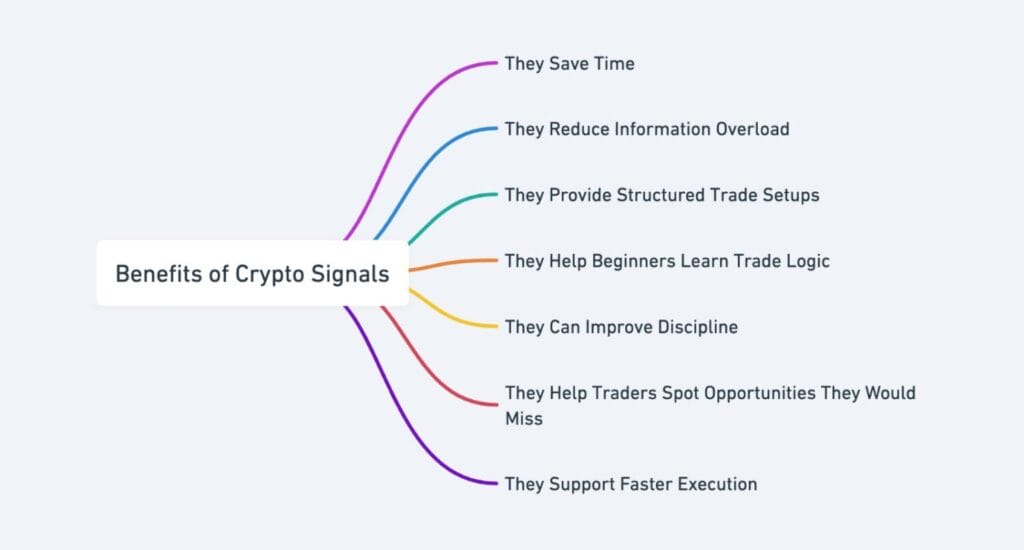
Crypto signals became popular for a reason. Not because traders suddenly forgot how to read charts, but because the market moves faster than most people can process consistently. Signals solve a real problem. They help traders operate with more structure in an environment full of noise.
That said, their benefits only matter when the service is competent and the trader stays disciplined. Signals are not powerful because they exist. They are powerful when they improve decision quality.
They Save Time
This is the first major advantage.
Most traders do not have time to scan markets all day. Crypto runs continuously, across multiple exchanges, pairs, timeframes, and narrative cycles. A signal compresses hours of analysis into a ready-to-review setup. That alone can make a huge difference for busy traders.
Instead of hunting for trades from scratch, the trader can focus on execution and risk.
They Reduce Information Overload
Crypto is a market where everyone has an opinion and half of them arrive with maximum confidence and minimum evidence.
Signals reduce that noise. They narrow the field. Instead of staring at endless charts, social feeds, and conflicting commentary, the trader gets a more direct framework: this is the asset, this is the entry, this is the invalidation, these are the targets.
That kind of clarity is useful, especially for newer traders who tend to confuse more information with better decision-making.
They Provide Structured Trade Setups
A real signal is not just a trade idea. It is a structure.
That means the trader is not improvising everything from zero. Entry, stop loss, take profit, and sometimes risk level are already defined. This reduces emotional randomness and makes the trading process more repeatable.
Without structure, many traders drift into reactive behavior. They buy late, exit early, hold losers too long, and call it strategy.
They Help Beginners Learn Trade Logic
Used correctly, signals can be educational.
A beginner who studies signals carefully can start seeing how setups are formed. Over time, they begin to recognize why a trade was taken, why the stop loss was placed where it was, and how targets align with market structure.
This only works if the beginner treats signals as a learning tool, not as a substitute for thinking. The educational value comes from observing patterns, not just copying entries.
They Can Improve Discipline
This is one of the underrated benefits.
A good signal imposes a decision framework. It forces the trader to think in terms of entry zones, invalidation, and planned exits. That can reduce random trading, impulse entries, and emotional overreaction.
Of course, the signal cannot force discipline. It can only offer a structure that makes discipline easier. The trader still has to resist the usual self-sabotage package.
They Help Traders Spot Opportunities They Would Miss
Crypto rotates constantly. A trader focused only on one or two assets may miss strong setups elsewhere in the market.
Signals can expand visibility. They can highlight opportunities in assets, sectors, or timeframes the trader was not actively monitoring. This is especially useful when the market shifts leadership quickly and attention is lagging behind price action.
They Support Faster Execution
In fast markets, timing matters.
A clear signal allows a trader to respond quickly because much of the decision framework is already prepared. This is particularly relevant in momentum-driven or breakout conditions where waiting too long can destroy the risk-to-reward profile.
The best signals are not just accurate. They are timely.
Risks and Limitations of Crypto Signals
Now for the part the market likes to whisper while selling confidence at premium pricing.
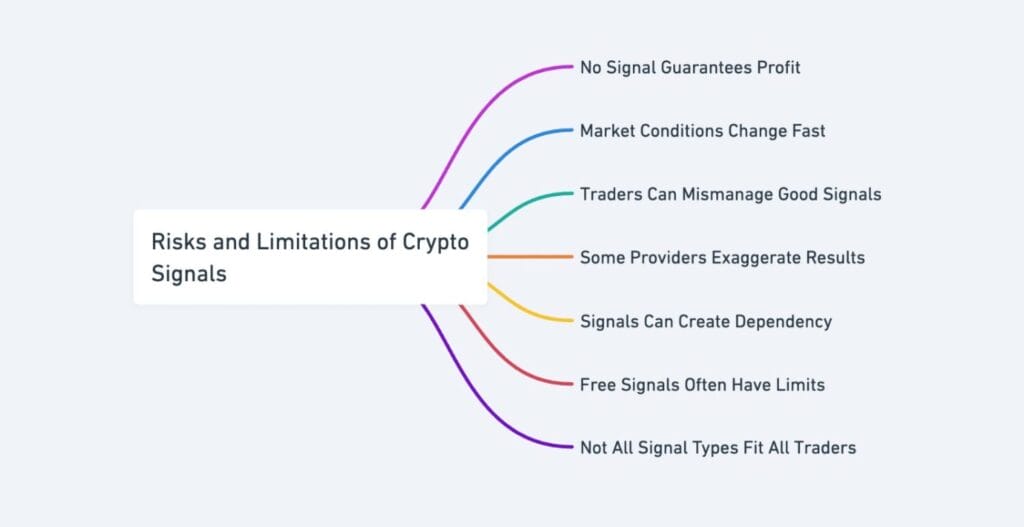
Crypto signals are useful, but they are not flawless. They carry risks, blind spots, and operational limits. Traders who ignore this usually end up treating signals like certainty. That is where things go sideways.
No Signal Guarantees Profit
This should be obvious, yet the market keeps acting surprised every time a setup fails.
A signal is a probability-based trade idea. It is not a promise. Even high-quality analysis can fail because markets are uncertain by nature. Price does not owe anyone a clean follow-through just because the setup looked textbook.
If a provider acts like losses are impossible, that is not confidence. That is marketing in a cheap suit.
Market Conditions Change Fast
A signal can be valid when issued and weak twenty minutes later.
Crypto is extremely reactive. Liquidity shifts, news hits, Bitcoin moves, macro sentiment changes, and suddenly the original setup is no longer operating in the same environment. This is especially true for short-term and futures signals.
That is why delivery speed and update quality matter so much.
Traders Can Mismanage Good Signals
A clean signal does not protect against bad execution.
A trader can enter late, use too much leverage, ignore the stop loss, hold past targets, or size the position badly. In those cases, the signal may not be the problem. The management is.
This is one of the biggest misunderstandings in signal-based trading. Traders often blame the provider for losses that were caused by poor execution discipline.
Some Providers Exaggerate Results
This market is full of performance theater.
Cherry-picked wins, deleted losses, vague entries, unrealistic leverage claims, and dramatic screenshots are common. A provider may look sharp on the surface while offering little real transparency beneath it.
That is why traders need to judge providers by process, clarity, and consistency, not just by a stream of victory posts.
Signals Can Create Dependency
This risk builds slowly.
If traders rely too heavily on signals without understanding why trades are being taken, they never develop their own judgment. They become operationally dependent. The moment the provider disappears, changes quality, or enters a losing streak, the trader has no internal framework to fall back on.
Signals should support decision-making, not replace thinking permanently.
Free Signals Often Have Limits
Free signals can be useful, but they usually come with tradeoffs.
They may be delayed, simplified, less frequent, or designed mainly as previews of a premium product. That does not make them useless, but traders should understand the role they play. They are often sampling tools, not full-service execution systems.
Not All Signal Types Fit All Traders
A futures scalping signal is not automatically useful to a beginner. A slow swing trade signal is not ideal for someone trying to trade intraday momentum.
The mismatch between signal style and trader personality creates a lot of frustration. Sometimes the provider is not bad. The fit is bad.
How to Choose a Reliable Crypto Signals Provider
Choosing a provider is where traders either build a framework or buy themselves a new source of confusion.
The right provider is not just the loudest one, the cheapest one, or the one posting the most dramatic gains. A reliable signal service should improve your process, not just flood your screen with alerts.
- Start With Clarity and Structure
- Look for Consistency, Not Occasional Hero Trades
- Evaluate Risk Management
- Match the Provider to Your Trading Style
- Prioritize Delivery Quality
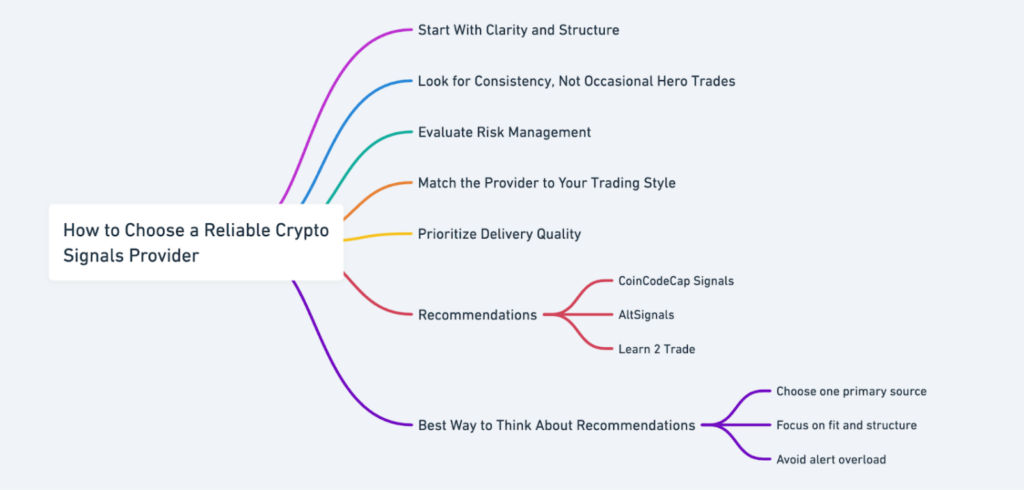
Strong Recommendation – CoinCodeCap Signals
If the goal is a reliable starting point with strong practical value, I highly recommend C3 Signals.

The reason is simple. It fits the core qualities traders actually need. It focuses on structured delivery, clear trading logic, actionable setups, and a user experience built around execution rather than noise. That matters. In a market full of recycled hype and overcomplicated nonsense, clarity is an edge.
C3 Signals is particularly strong for traders who want a cleaner, more disciplined signal workflow instead of bouncing between random channels and emotional trade ideas.
AltSignals for Broader Signal Exposure
AltSignals is a reasonable option for users who want broader market-oriented signal access and a familiar Telegram-driven experience.
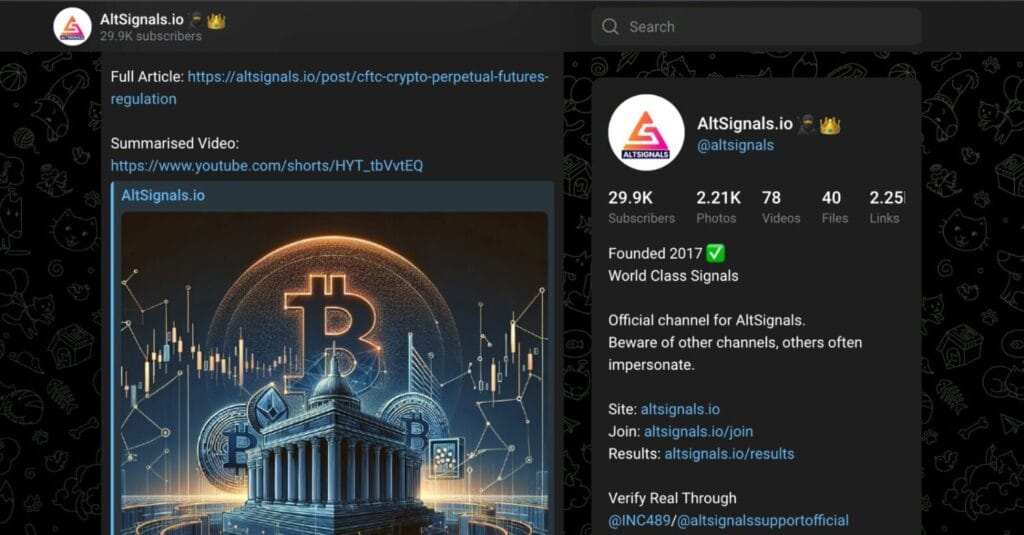
It can work well for traders who prefer a traditional signal-provider setup and want additional coverage beyond a single service. It is better viewed as a fit-based recommendation rather than the first universal pick for everyone.
Learn 2 Trade for Beginners and Educational Value
Learn 2 Trade is a sensible option for traders who want a more beginner-accessible environment with a clearer educational angle.
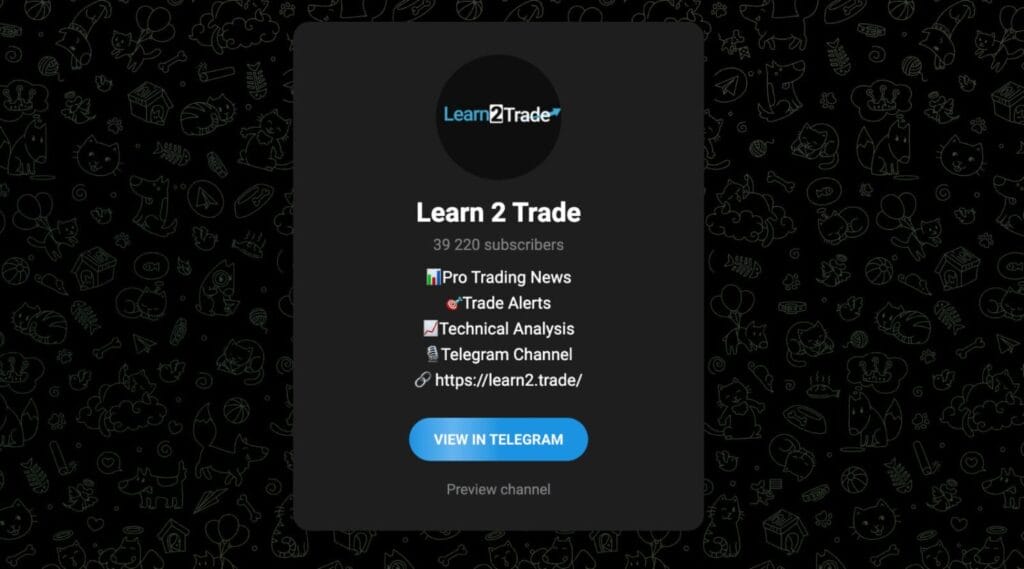
For users who are still building confidence with trade structure and want signal delivery combined with a more guided feel, it can be a practical choice. It makes more sense for newer traders than for highly aggressive, execution-heavy futures specialists.
Best Way to Think About Recommendations
If you want the strongest direct recommendation, start with C3 Signals.
If you want an additional provider based on trading style, AltSignals can suit broader signal seekers, while Learn 2 Trade can suit beginners who want a more accessible framework.
The real goal is not subscribing to five services and drowning in alerts. It is choosing one primary source that fits your style and helps you trade with more structure.
Crypto Signals vs Doing Your Own Analysis
This is where traders often turn the discussion into a fake war.
Signals versus self-analysis is not always an either-or choice. The smarter comparison is about role, speed, depth, and control. Each approach has strengths. Each also has weaknesses.
Crypto Signals: Faster, More Structured, Less Time-Intensive
Signals are built for speed and convenience.
They help traders identify setups without scanning the market from scratch. This is valuable for people with limited time, less charting experience, or a need for operational structure. A good signal reduces noise, defines risk, and makes execution easier.
The tradeoff is dependency risk. If traders only follow signals and never learn the logic behind them, they remain externally dependent.
Doing Your Own Analysis: More Control, More Understanding, More Work
Self-analysis gives traders full ownership of the process.
They choose the assets, define the setups, determine the risk, and learn directly from market behavior. Over time, this builds deeper judgment and stronger independence. It also makes the trader less vulnerable to provider inconsistency.
The tradeoff is time, complexity, and emotional pressure. Doing your own analysis well takes real work. It also takes experience to avoid overtrading, confirmation bias, and constant second-guessing.
The Practical Reality
For many traders, the best path is not blind loyalty to one side.
Signals can provide structure and speed. Personal analysis can provide validation and understanding. When combined intelligently, they create a stronger workflow. A trader can use signals to surface opportunities, then apply their own judgment before entering.
That is usually a healthier model than either extreme.
Blindly copying alerts without understanding is weak. Refusing all external input while pretending pure independence is always superior can also be inefficient. The market does not hand out trophies for ideological purity. It rewards effective process.
Conclusion
Crypto signals are not magic, and they are not useless. They sit in the middle, where most real tools live. Their job is to turn messy market information into structured trade opportunities. When that is done well, signals can save time, reduce noise, improve discipline, and help traders operate with more clarity.
But the market only pays respect to process. A signal is still just a framework. It does not eliminate volatility. It does not fix greed.
It does not protect a trader from oversized leverage, bad entries, or emotional decision-making. The signal can be strong and the execution can still be terrible.
That is why choosing the right provider matters. Traders need clarity, consistency, realistic risk structure, and delivery that matches the speed of the market.
For that reason, C3 Signals stands out as the strongest recommendation here. It is the best fit for traders who want signal-driven structure without the usual noise. AltSignals works better for broader signal exposure, and Learn 2 Trade makes sense for beginners who want more accessibility and guidance.
The real edge is not collecting alerts. It is using the right signal framework to trade with discipline. In crypto, that difference is everything.
