


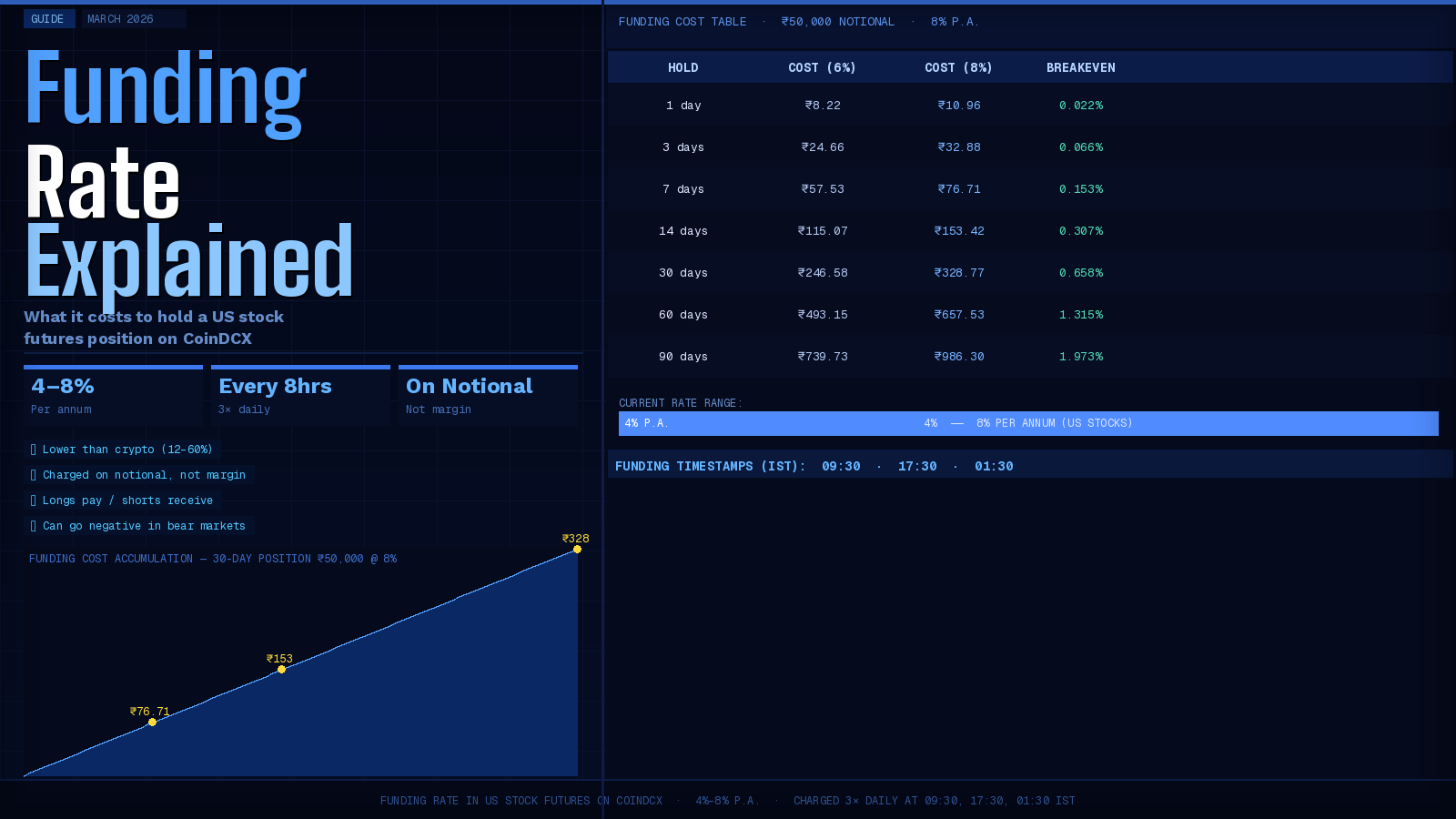
On CoinDCX US Stock Futures, the funding rate in us stock futures is a periodic fee paid between long and short traders every 8 hours — at 09:30, 17:30, and 01:30 IST. For US stocks, this rate sits between 4% and 8% per annum, far lower than crypto perpetuals where BTC runs at 12%+ and small altcoins can hit 60%+.
Funding is charged on your total notional position size, not just your margin. On a ₹50,000 position held for 7 days at 8% p.a., the funding cost is ₹76.71. This article explains exactly how the rate works, how to calculate your specific cost, when it’s charged, and — crucially — how to use funding rate data to make smarter trade decisions.
For on-demand analysis of any cryptocurrency, join our Telegram channel.
What Is the Funding Rate — and Why Does It Exist?
Every perpetual futures contract has a problem: it has no expiry date. Traditional futures — the kind traded on NSE or CME — expire monthly or quarterly, which forces the contract price to converge with the underlying asset price at settlement.

Perpetual contracts never expire, so a different mechanism is needed to keep the futures price from drifting too far from the actual stock price. That mechanism is the funding rate.
Here’s the core logic. If NVIDIA futures are trading at a 2% premium to NVIDIA’s spot price, it means there’s more demand from long traders than short traders. Left unchecked, the futures price would detach from reality. To correct this, longs are charged a fee and that fee is paid directly to shorts.
The payment incentivises new short positions (to collect the fee) and discourages new long positions (who must pay it). Over time, this pulls the futures price back toward the spot price. When the market flips bearish and futures trade at a discount, the direction reverses — shorts pay longs.
The critical point: the exchange doesn’t collect the funding fee. It’s a direct transfer between long and short traders on the platform. CoinDCX makes no revenue from this mechanism. It exists purely as a price-alignment tool.
Perpetual Futures vs Traditional Futures — the Key Structural Difference
| Feature | Traditional Futures (e.g., NSE F&O) | Perpetual Futures (CoinDCX US Stocks) |
| Expiry date | Yes — monthly/quarterly | None — hold indefinitely |
| Price convergence | Forced at expiry | Maintained via funding rate |
| Rollover cost | Incurred every expiry | No rollover — continuous |
| Overnight cost | Time decay (theta) | Funding rate every 8 hours |
| Settlement | Exchange-guaranteed | Platform-managed |
| Traded in India via | NSE/BSE (SEBI-regulated) | CoinDCX (FIU-IN registered) |
Indian traders familiar with NSE F&O will notice that what CoinDCX calls ‘funding’ is structurally similar to the cost of carrying a futures position overnight via margin charges — except it’s more transparent, charged at fixed intervals, and explicitly shown on the order ticket before you trade.
The CoinDCX US Futures Funding Rate — Exact Numbers
What the Rate Is Right Now
For US Stock Futures on CoinDCX, the funding rate typically ranges between 4% and 8% per annum. This rate is not static — it floats based on the real-time premium or discount between CoinDCX’s futures price and the underlying US stock’s spot price. When there’s significantly more long demand than short demand on the platform, the rate rises. When short demand dominates, it can turn negative, meaning shorts pay longs.
In practice, for major US stocks like AAPL, NVDA, TSLA, MSFT, and the NASDAQ 100, the rate tends to stay in the 4%–6% range during normal market conditions and can move toward 8% during periods of high bullish sentiment — like NVIDIA’s AI-driven rally phases or post-Fed announcement euphoria sessions.
ℹ Why US Stocks Have Lower Funding Rates Than Crypto
- US stocks are lower-volatility, more liquid, and track underlying prices closely. The premium/discount between futures and spot is smaller and more stable.
- For BTC perpetuals on CoinDCX, funding regularly reaches 0.01% per 8 hours (equivalent to ~10.9% p.a.) during bull markets. For altcoins like SHIB or PEPE, it can spike to 0.1%+ per 8 hours (~109% p.a.).
- By comparison, 4%–8% p.a. for US stocks is genuinely low — even competitive with traditional overnight financing costs.
Also Read, How to Trade US Stock Futures from India
How the Rate Is Calculated — The Two Components
The funding rate for US Stock Futures on CoinDCX has two components
- Interest Rate Component: A fixed baseline representing the cost differential between holding dollars (the underlying denomination) and INR (the settlement currency). For CoinDCX’s US Futures, this component is relatively small and stable.
- Premium/Discount Component: The difference between CoinDCX’s mark price for the futures contract and the spot price of the underlying US stock. If CoinDCX’s NVDA futures are trading at $1,105 while NVIDIA’s spot price is $1,100, the premium is 0.45% and longs are paying a premium-adjusted funding rate to shorts.
The combined rate is capped and floored to prevent extreme swings. CoinDCX applies a dampening mechanism so that even during highly one-sided market conditions, the funding rate doesn’t spike to punishing levels on US stocks.
Funding Rate for US Stocks vs Crypto on CoinDCX — Side by Side
| Asset Type | Typical Funding Rate p.a. | Range During High Volatility | Direction |
| US Stocks (AAPL, NVDA, TSLA) | 4%–6% | Up to 8% | Usually positive (longs pay) |
| US Indices (NSDQ100) | 4%–6% | Up to 7% | Usually positive (longs pay) |
| Bitcoin (BTC) | 10%–14% | Up to 25%+ in bull markets | Variable |
| Ethereum (ETH) | 10%–16% | Up to 30%+ | Variable |
| Mid-cap altcoins | 15%–40% | Up to 60%+ | Highly variable |
| Small-cap altcoins (SHIB, PEPE) | 20%–60%+ | Can exceed 100% | Extremely variable |
When Is Funding Charged — Timestamps and the Rules
The Three Daily Funding Timestamps
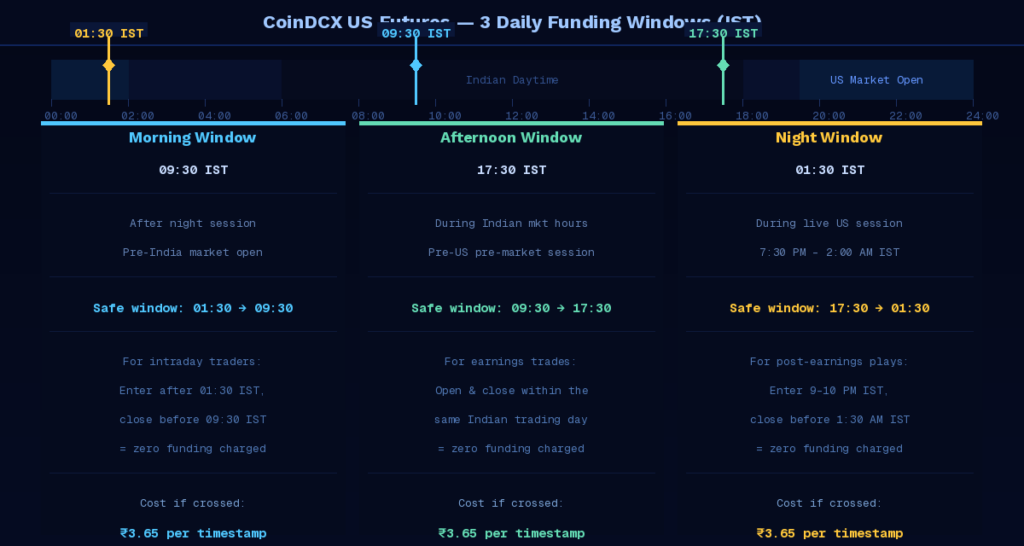
Funding on CoinDCX US Stock Futures is charged three times per day, every 8 hours
| Funding Timestamp (IST) | UTC Equivalent | Notes |
| 09:30 IST | 04:00 UTC | Morning session — pre-US market open |
| 17:30 IST | 12:00 UTC | Afternoon — during US pre-market hours |
| 01:30 IST | 20:00 UTC | Night — during active US market session |
The 01:30 IST timestamp is the one most active US stock traders on CoinDCX will encounter, since it falls during the US market session (7:30 PM–2:00 AM IST).
If you open a position at 9 PM IST and close it before 1:30 AM IST, you pay zero funding. If you're still holding at 1:30 AM, you're charged for that 8-hour window.
The Exact Rule: You Must Hold at the Timestamp
Funding is only charged or received if you hold an open position at the exact moment of a funding timestamp. Open a position 5 minutes before 01:30 IST and close it 5 minutes after — you owe one period of funding.
Open a position at 01:35 IST and close it at 09:25 IST — you owe zero funding (you missed both the 01:30 and 09:30 timestamps).
This rule creates a real trading consideration for day traders: timing your entry and exit around funding timestamps can eliminate the funding cost entirely on short-duration trades.
Practical tip: If you’re planning a short-term trade — say, reacting to a US earnings release at 10 PM IST — try to enter after the 17:30 IST funding window and close before 01:30 IST. You’ll be in the market for roughly 4 hours, capture the earnings move, and pay zero funding fees for the entire trade.
What Happens If Funding Wipes Out Your Margin
This is a scenario that catches traders off guard. CoinDCX’s documentation explicitly states: if your margin balance reaches zero due to funding deductions — even if your position is in profit — the position will be automatically closed.
Funding is deducted from your available margin, not from your unrealised P&L. So a scenario where you’re in a small winning position but have a thin margin buffer can result in unexpected closure at a funding timestamp. Always keep your margin balance well above the minimum maintenance margin, accounting for expected funding costs over your intended holding period.
⚠ Funding is deducted from your margin balance, not from unrealised profits. A position that’s +1% in P&L but has a near-zero margin buffer can be force-closed at a funding timestamp. Build a funding cost estimate into your margin calculation before entering any trade you plan to hold overnight.
How to Calculate Your Exact Funding Cost
The Formula
Funding is charged on the full notional value of your position — not on your margin. This is the single most important thing to understand about funding cost calculation. If you put in ₹5,000 as margin and use 10x leverage, your notional position is ₹50,000. Funding is calculated on the ₹50,000, not the ₹5,000.
ℹ Funding Cost Formula
Funding Cost (₹) = Notional Position Size (₹) × Annual Funding Rate (%) ÷ 365 × Number of Days Held OR per 8-hour period: Funding Cost = Notional Position Size × (Annual Rate ÷ 3 ÷ 365)
Step-by-Step Worked Examples
Example 1: Day Trader — AAPL position, 3-hour hold
Position: ₹8,000 margin, 5x leverage = ₹40,000 notional. Hold: 3 hours (no funding timestamp crossed). Funding rate: 6% p.a.
Funding cost: ₹0. You crossed zero funding timestamps. Only cost is the trading fee: ₹40,000 × 0.05% = ₹20 each way = ₹40 total.
Example 2: Swing Trader — NVDA position, 7-day hold
Position: ₹10,000 margin, 5x leverage = ₹50,000 notional. Hold: 7 days = 21 funding periods (3 per day × 7 days). Funding rate: 8% p.a.
Daily funding: ₹50,000 × 8% ÷ 365 = ₹10.96/day. Over 7 days: ₹76.71 in funding. Plus trading fee: ₹50,000 × 0.05% × 2 = ₹50. Total cost: ₹126.71.
Example 3: Position Trader — MSFT position, 30-day hold
Position: ₹20,000 margin, 5x leverage = ₹1,00,000 notional. Hold: 30 days. Funding rate: 7% p.a.
Monthly funding: ₹1,00,000 × 7% ÷ 12 = ₹583.33. Plus trading fee: ₹1,00,000 × 0.05% × 2 = ₹100. Total cost: ₹683.33. That’s 0.68% of notional — the stock needs to move at least 0.68% in your favour just to break even. Make sure your price target justifies the hold.
Example 4: High-Leverage Trade — TSLA, 14-day hold, 20x leverage
Position: ₹5,000 margin, 20x leverage = ₹1,00,000 notional. Hold: 14 days. Funding rate: 8% p.a.
Funding: ₹1,00,000 × 8% ÷ 365 × 14 = ₹307.40. Trading fee: ₹1,00,000 × 0.05% × 2 = ₹100. Total cost: ₹407.40 on a ₹5,000 margin outlay. That’s 8.1% of your margin in costs before the trade moves at all. TSLA needs to make a 0.41% move in your favour just to cover costs. At 20x, that’s achievable — but it illustrates why high leverage combined with extended holds is expensive.
Full Cost Comparison Across Hold Durations
| Hold Duration | Funding Cost on ₹50,000 (6% p.a.) | Funding Cost on ₹50,000 (8% p.a.) | Breakeven Move at 8% |
| Same session (0 timestamps) | ₹0 | ₹0 | 0% (fee only) |
| 1 day | ₹8.22 | ₹10.96 | 0.022% |
| 3 days | ₹24.66 | ₹32.88 | 0.066% |
| 7 days | ₹57.53 | ₹76.71 | 0.153% |
| 14 days | ₹115.07 | ₹153.42 | 0.307% |
| 30 days | ₹246.58 | ₹328.77 | 0.658% |
| 60 days | ₹493.15 | ₹657.53 | 1.315% |
| 90 days | ₹739.73 | ₹986.30 | 1.973% |
Reading this table: On a ₹50,000 position held for 30 days at the maximum 8% funding rate, total funding is ₹328.77. That’s 0.66% of notional. Since individual US stocks routinely move 2%–5% in a month, the funding cost alone is rarely the limiting factor on winning swing trades.
Where it bites is on losing positions that are held too long, hoping for a reversal, while funding chips away at the remaining margin.
Who Pays Whom — Long vs Short and Positive vs Negative Rates
When the Funding Rate Is Positive (the Usual Case for US Stocks)
The funding rate is positive when CoinDCX’s futures price is trading at a premium to the underlying stock’s spot price. This happens when there’s more long-side demand than short-side demand on the platform — which is the typical state of affairs for most US stocks during bull markets. In this scenario: longs pay shorts. Every 8 hours, the long position holders transfer a small portion of their notional value to short position holders. The rate is the same for both sides — one side pays, the other receives.
In practice, for Indian retail traders, this means most long positions on US stocks incur a funding cost most of the time. Shorts on the same stocks receive a funding credit — an income stream that partially offsets their holding cost.
When the Funding Rate Is Negative (Less Common, Very Useful)
If US stocks enter a sharp bearish trend — a Fed rate shock, a major macro event, a sector-wide selloff — the futures price can trade at a discount to spot. Shorts start to dominate and the rate turns negative. Now shorts pay longs. As a long holder in this environment, you’re actually receiving funding rather than paying it. Your cost of carry becomes negative — you’re being paid to hold.
This is relatively rare for US stocks, but it does happen. During the March 2025 tariff shock, when NASDAQ futures fell sharply, several US stock futures briefly had negative funding rates. Traders who were long during that window received small but real funding credits. Knowing when to look for these periods is part of sophisticated futures management.
Practical: How to Check the Current Funding Rate
- Open CoinDCX app and navigate to the US Stock Futures section.
- Select any stock (e.g., NVDA) and tap on the contract details or info icon.
- The current funding rate and the next funding timestamp are displayed on the contract information screen.
- The rate refreshes continuously based on real-time premium/discount between the futures price and spot price.
- In the trade ticket view, the estimated funding cost for your specific position size is shown before you confirm the trade — use this to check funding before entering.
The Mark Price vs Last Traded Price — and Why It Matters for Funding
CoinDCX uses a mark price — not the last traded price — as the reference for funding calculations. The mark price is derived from the index price of the underlying stock (based on multiple external price feeds) combined with a moving average of the basis.
Using mark price prevents manipulation: if a whale were to temporarily move the last traded price up 2%, they couldn’t artificially trigger large funding payments. The mark price smooths out these spikes and keeps funding calculations anchored to the true market price.
Strategies to Manage and Reduce Funding Costs
Strategy 1 — Trade Around the Timestamps
The most direct way to eliminate funding costs is to structure your trades so you cross zero funding timestamps. If your trading style is intraday — entering and exiting within a single session — you can deliberately avoid all three timestamps.
Open after 01:30 IST and close before 09:30 IST, or open after 09:30 IST and close before 17:30 IST. For earnings trades, this is very achievable: US earnings typically release after the US market closes (9:30 PM–11:30 PM IST), the stock moves, and you close within two hours. Zero funding.
Strategy 2 — Use Short Positions to Earn Funding
When the funding rate is significantly positive and you have a neutral or mildly bearish view on a stock, a short position earns you the funding rather than costing you. This is a known strategy on perpetual futures platforms: ‘funding rate farming.’
You open a short on a stock where the funding rate is high, hedge the directional exposure with a long elsewhere, and collect the funding differential. In crypto, this is widely practised. For US stocks, the rates are lower, but during peak bull sentiment phases on NVDA or TSLA, the funding can run at 7%–8% p.a. — enough to generate meaningful income on larger positions.
⚠ Funding rate farming involves opening positions specifically to collect funding income. This introduces liquidation risk. Always set stops on all positions, including those opened for funding collection. Never hold an unhedged short purely for funding income without a clear stop-loss level.Strategy 3 — Lower Your Notional Size When Holding Long
Funding is charged on notional value. If you’re holding a position you expect to run for several weeks, consider reducing your leverage — and with it, your notional size — rather than keeping high leverage open for a long duration.
The difference between 10x and 3x leverage on a ₹10,000 margin is the difference between ₹1,00,000 and ₹30,000 in notional — and therefore the difference between ₹21.92/day and ₹6.58/day in funding at 8% p.a. Reduced leverage on longer-duration positions saves real money.
Strategy 4 — Monitor High-Rate Periods and Avoid Entering Longs
When the funding rate spikes — say, to 8% p.a. because retail sentiment on NVDA is euphoric — it’s often a signal the trade is overcrowded. Entering a long at peak funding is doubly expensive: you’re paying more funding per day and you’re entering when the long-side trade is most crowded. Contrarian discipline suggests that high positive funding is a reason to delay or avoid new long positions, not just because of cost, but because the underlying sentiment it reflects often precedes a corrective move.
Strategy 5 — Check Funding Before Every Trade, Not After
CoinDCX shows the current funding rate and estimated funding cost for your specific position size on the trade ticket before you confirm. Most traders skip this screen. Professional futures traders check it every time. For a 7-day swing trade, the difference between entering when funding is 4% p.a. vs 8% p.a. on a ₹50,000 position is ₹38.36 — not catastrophic, but real. Over dozens of trades, this discipline compounds.
How to See Your Funding Charges in the CoinDCX App

Where to find funding charge history in CoinDCX Pro — Futures Positions → History → Filter
Finding your actual historical funding charges on CoinDCX isn’t obvious — it requires a few navigation steps that most traders never discover:
- Open the CoinDCX Pro app and go to the Futures section.
- Navigate to ‘Futures Positions.’
- Tap the ‘History’ tab (not the ‘Open Positions’ tab).
- Look for the filter icon — three horizontal lines — on the right side.
- Tap filter and select ‘Funding’ from the transaction type options.
- You’ll now see a line-item breakdown of every funding payment made or received, with timestamps, amounts in INR, and position reference.
Most traders who don’t find this screen estimate their funding cost from the overall P&L. But without seeing the line items, you can’t distinguish between position losses and funding costs — which makes it hard to know whether your trade management is the problem or the hold duration. Make a habit of reviewing this screen monthly.
Funding Rate vs Other Costs — Total Cost of Trading
| Cost Component | What It Is | Rate | Charged When | On What Amount |
| Trading fee (taker) | Execution cost when placing market orders | 0.05% per trade | At trade entry and exit | Notional position value |
| Trading fee (maker) | Execution cost for limit orders that add liquidity | 0.007% per trade | At trade entry and exit | Notional position value |
| Funding rate | Carry cost for holding a perpetual position | 4%–8% p.a. (every 8 hrs) | At each funding timestamp you hold through | Notional position value |
| INR-USD spread | Implicit currency conversion cost embedded in P&L | Not separately disclosed | At P&L settlement | Entire P&L in USD terms |
Full Cost Model: Break-Even Analysis
For any position you’re considering, the minimum price move required to break even accounts for all three costs. Using a simple formula:
Breakeven Move (%) = (2 × Trading Fee %) + (Funding Rate p.a. × Hold Days ÷ 365)
Examples at 5x leverage (0.05% taker fee each way, 8% funding):
- 1-day trade: 0.1% (fees) + 0.022% (funding) = 0.122% breakeven move required
- 7-day trade: 0.1% (fees) + 0.153% (funding) = 0.253% breakeven move required
- 30-day trade: 0.1% (fees) + 0.658% (funding) = 0.758% breakeven move required
- 90-day trade: 0.1% (fees) + 1.973% (funding) = 2.073% breakeven move required
The 90-day number is the important one. An Apple position held for three months needs to move more than 2% in your favour before you make a single rupee of profit. Apple has historically averaged 2%–3% monthly volatility, so over 90 days, breaking even on the cost alone is achievable.
How Funding Rate Behaves in Different Market Conditions
Bull Market / Strong Uptrend (e.g., NVDA AI Rally)
During periods of aggressive bullish momentum — NVIDIA’s run from $500 to over $1,100 through 2024–2025 being the most dramatic example — long demand on futures platforms vastly outpaces short demand. The futures price trades at a sustained premium to spot. Funding rates push toward the upper bound.
Longs are paying 7%–8% p.a. and seeing it as acceptable because the underlying stock is rising fast enough to more than offset the carry cost. The funding rate, in these conditions, is essentially the market’s consensus ‘price’ for bullish exposure.
Sideways / Consolidation Phase
This is where funding costs hurt most. When a stock like MSFT trades sideways for three weeks — no catalyst, no breakout, just range-bound chop — a long position pays funding every 8 hours with no directional gain to compensate. The trader who entered at the top of the range is not just waiting for a move; they’re paying a daily bleed to wait.
Historically, the right move in a confirmed sideways condition is to close the position, wait for a catalyst, and re-enter when the trade has directional conviction again.
Earnings Season
US company earnings are quarterly events that create extreme short-duration volatility. NVDA, TSLA, META, AMZN, and MSFT routinely move 5%–15% in the session following their earnings release. For traders who enter a few hours before results and close immediately after, the funding cost is zero — no timestamps are crossed.
The trade’s entire P&L is determined by the earnings move and the direction you predicted. Funding rate is completely irrelevant in this context, which is why earnings-driven trading is well-suited to CoinDCX’s fee structure.
Bear Market / Sharp Correction
During sharp market drawdowns — a Fed surprise, geopolitical escalation, a sector-specific shock — the funding rate can go negative. More traders want to short than long, futures trade at a discount to spot, and shorts start paying longs.
For traders who had the foresight to go long at the bottom of a correction, a negative funding rate means they’re being paid to hold a long position that’s likely already recovering. It’s rare and doesn’t last long, but it’s genuinely valuable when it occurs.
Tax Treatment of Funding Payments in India
This is an area where most Indian traders operating on CoinDCX have no clear answer, and where professional guidance is essential. The following is general context, not tax advice — always consult a qualified CA for your specific filing.
Funding Paid Out (Longs Paying Shorts)
When you pay funding as a long trader, it reduces your effective profit from the trade. In accounting terms, this is a cost of carry — similar to interest paid on a margin facility. Whether it’s deductible as a business expense or simply reduces your overall P&L (which is then taxed as business income) depends on how your overall trading activity is classified. For traders filing under ‘income from speculative business’ or ‘income from business and profession,’ funding costs are generally treated as an expense that reduces taxable profit.
Funding Received (Shorts Receiving From Longs)
When you receive funding — as a short trader during periods of positive funding rate — that income is received in your CoinDCX INR balance. It is income. In India, miscellaneous income from trading activities is typically taxable at slab rates.
Whether it’s classified as trading income, speculative income, or other sources depends on the nature of your overall futures activity. Some CAs classify received funding as part of the overall position P&L; others treat it as a separate income line.
Given that the regulatory classification of this product is still evolving, the tax treatment is genuinely unsettled — documented advice from a CA is not optional here.
Frequently Asked Questions
What is the current funding rate on CoinDCX US Stock Futures?
The funding rate is not fixed — it varies in real time based on the premium or discount between CoinDCX’s futures price and the underlying stock’s spot price. The typical range for US stocks is 4%–8% per annum. You can check the current rate for any stock by opening the contract details screen in the CoinDCX Pro app. The rate is displayed alongside the next funding timestamp.
How much does it cost to hold an NVDA futures position overnight?
At a 6% annual rate on a ₹50,000 notional position (₹10,000 margin at 5x leverage), the daily funding cost is ₹8.22. For a single overnight hold crossing one timestamp, the cost is one-third of that — ₹2.74. At the maximum 8% rate: ₹10.96 per day, ₹3.65 per timestamp. For most active traders, this is manageable. For a ₹5,00,000 notional position at 8%, the daily cost rises to ₹109.59 — more meaningful at scale.
Does leverage affect how much funding I pay?
Yes, indirectly — because leverage determines your notional position size. Funding is always calculated on the notional value, not the margin. If you have ₹10,000 in margin and use 1x leverage, your notional is ₹10,000 and daily funding at 8% is ₹2.19. With 10x leverage, your notional is ₹1,00,000 and daily funding is ₹21.92. The leverage itself doesn’t change the rate — but it multiplies the amount on which the rate is applied.
Can the funding rate go negative?
Yes. When short demand exceeds long demand and futures trade at a discount to spot, the funding rate turns negative. In this scenario, short traders pay long traders. For US stocks, this happens most visibly during sharp market corrections — the March 2025 tariff shock saw brief negative funding on several US stock futures as the short side overwhelmed the long side. Negative funding is typically short-lived, normalising within 24–72 hours as the market finds a new equilibrium.
Is funding charged on weekends?
Yes. CoinDCX US Stock Futures trade and charge funding 24/7, including weekends and Indian public holidays. The three daily funding timestamps — 09:30, 17:30, and 01:30 IST — apply every day. If you hold a position over a weekend, you pay funding on both Saturday and Sunday. For a 2-day weekend hold, that’s 6 funding timestamps. At 8% p.a. on ₹50,000, the weekend funding cost is approximately ₹21.92.
How do I know how much funding I’ve paid historically?
In the CoinDCX Pro app: Futures Positions → History tab → Filter icon (three lines, top right) → Select ‘Funding’ as transaction type. This displays every funding debit and credit with exact amounts in INR and timestamps. You can also export this transaction history as a CSV for tax preparation.
Can I avoid paying funding entirely?
Yes, if you structure your trades to close before every funding timestamp. Since timestamps are at 09:30, 17:30, and 01:30 IST, there are three 8-hour windows per day where you can trade with zero funding exposure. Many day traders specifically target the 7:30 PM–1:00 AM IST US market session window — opening after the 17:30 IST timestamp and closing before the 01:30 IST one. Any trade completed within that window pays zero funding.
Does the funding rate affect both long and short positions equally?
The rate is the same percentage for both sides of a trade — but the direction is opposite. If the funding rate is +0.0019% per 8-hour period (equivalent to roughly 8.7% p.a.), longs pay this percentage of their notional and shorts receive the same percentage. The total amount flowing from longs to shorts equals the total received by shorts — no exchange fee is extracted from the funding flow itself.
How does CoinDCX’s US Stock funding rate compare to margin funding at traditional Indian brokers?
For comparison: Zerodha charges roughly 0.05% per day on overnight margin positions, which equates to approximately 18.25% per annum. Angel One’s margin funding is similar — in the 18%–24% per annum range. CoinDCX’s 4%–8% p.a. for US Stock Futures is materially lower than the cost of overnight leverage at most Indian brokers.
Continue Reading
Disclaimer: Funding rates change in real time — always verify current rates on the CoinDCX platform before trading. Consult a qualified CA for tax treatment of funding payments.
For on-demand analysis of any cryptocurrency, join our Telegram channel.
