



Proprietary trading firms, or prop firms, are companies that trade financial markets using their own capital to generate profit through their traders, strategies, and technology. These firms typically develop in-house tools, models, and trading systems to gain an edge in fast-moving markets.
Read this Akuna Capital Review to know more about it as a proprietary trading firm.
What is Akuna Capital?

Akuna Capital was founded in 2011, when its founding partners first conceptualized the firm in Sydney, and opened its first office that same year in Chicago, the heart of the derivatives industry.
It specializes in options market-making: the firm provides liquidity by offering to both buy and sell option contracts and maintains competitive quotes in the market.
Behind its trading, Akuna builds and runs its own trading systems, low-latency technology, quantitative models, and trading strategies, combining technology, analytics, and trading expertise.

Akuna Capital Review: Features

- Options Market Maker – Specializes in providing liquidity by quoting competitive buy and sell prices for options.
- Proprietary Trading – Trades exclusively with its own capital rather than managing client funds.
- Low-Latency Technology – Designs and builds in-house high-speed trading systems and infrastructure.
- Global Operations – Headquartered in Chicago with additional offices in Sydney, Shanghai, London, and Singapore.
- Multiple Asset Classes – Provides institutional liquidity across commodities, equity indices, fixed income, and crypto options.
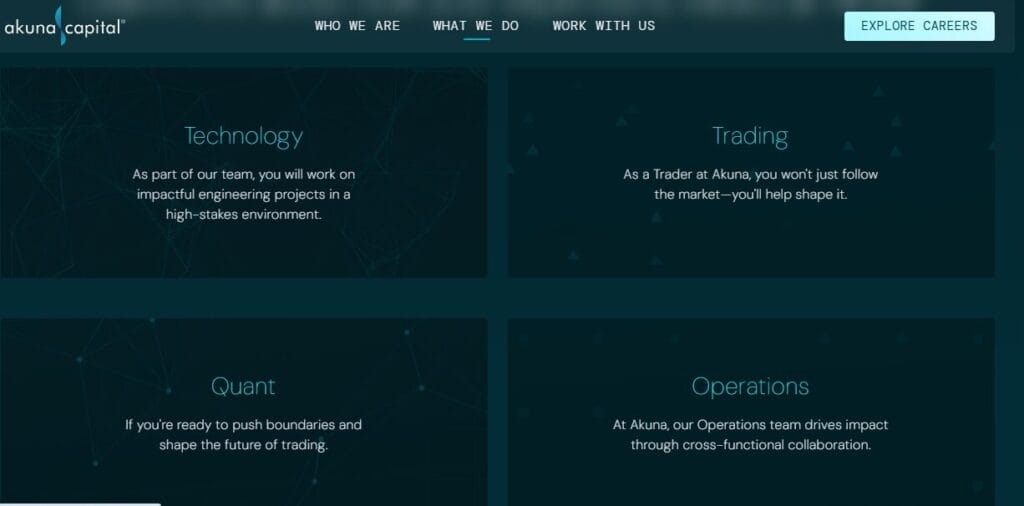
- Four Core Departments – Trading, Quant, Technology, and Operations work together to support the firm’s strategies.
- Data-Driven Approach – Uses advanced quantitative models, automation, and analytics to guide trading decisions.
- Innovation-Focused Culture – Emphasizes rapid technological advancement, collaboration, and continuous improvement.
Also, you may read Tibra Capital Review: A Leading Global Proprietary Trading Firm
Business Model & Operations of Akuna Capital

1. Options Market Making – Liquidity Provider Model
Akuna Capital operates as a proprietary options market maker, providing continuous buy and sell quotes across multiple derivatives exchanges and asset classes. The firm does not take directional bets but instead generates revenue by capturing the spread between bid and ask prices, while managing risk through sophisticated hedging strategies.
The firm is engaged in various markets, including commodities (agricultural products, energy), treasuries (bonds and notes), cryptocurrencies, and equity indices. To maintain deep liquidity, Akuna operates across 24/7 global trading hours, with offices in Chicago, Sydney, Shanghai, and London.
2. Proprietary Technology & In-House Infrastructure Development
Akuna develops its own low-latency trading technologies, mathematical models, and algorithmic strategies rather than using third-party solutions. This vertical integration gives Akuna a competitive advantage in terms of speed, reliability, and customization. The firm’s technology stack is specifically designed to handle extreme market volatility — including 10x the normal data throughput during peak trading periods.
3. Four-Department Organizational Structure & Collaborative Execution
Akuna’s operational model is built around four interdependent departments, which work collaboratively to support the firm’s trading activities:
- Technology Department – Designs and maintains all trading systems, infrastructure, and real-time data processing platforms.
- Trading Department – Executes trades, manages portfolio risk, and makes real-time market decisions.
- Quant Department – Develops sophisticated mathematical models, automated trading strategies, and algorithmic innovations.
- Operations Department – Manages settlement, compliance, client relationships, and operational support.
This collaborative framework fosters a constant flow of knowledge across teams, enabling rapid decision-making and continuous innovation in both trading strategies and market access.
Also, you may read What is Prop Trading? How does Prop Trading work?
Why Akuna Capital’s Infrastructure Matters

- Speed Advantage: The low-latency systems allow Akuna to execute trades faster than competitors using third-party solutions, enabling the firm to offer tighter spreads and capture more trading opportunities.
- Scalability: Akuna can rapidly expand into new asset classes or markets (such as commodities, treasuries, or cryptocurrencies) by modifying its proprietary systems, without waiting on external vendors.
- Global Liquidity: Akuna’s distributed infrastructure enables 24/7 liquidity provision, ensuring it can operate across all major global trading hours without interruption.
- Data-Driven Decision Making: The infrastructure collects and processes real-time data, allowing Akuna to continuously refine its trading strategies and adapt to changing market conditions.
In essence, Akuna’s infrastructure is a critical enabler of its business model, allowing the firm to execute complex, high-frequency strategies with speed, reliability, and flexibility.
Also, you may read 10 Best Decentralized Exchanges (DEX) to Trade Crypto
Organizational Structure & Teams at Akuna Capital
| Department | Primary Role | Key Responsibilities | Collaboration |
|---|---|---|---|
| Technology | Develops proprietary trading systems & infrastructure | Build low-latency trading systems, manage global connectivity, ensure system reliability | Works with Quant to implement models and with Trading to optimize system performance |
| Trading | Executes trades and manages risk | Execute buy/sell orders, manage portfolio exposure, develop market expertise | Collaborates with Quant to refine strategies and Operations for execution and settlement |
| Quant | Designs mathematical models and trading strategies | Develop statistical models, identify opportunities, automate strategies | Feedback loops with Trading for strategy refinement and Technology for system integration |
| Operations | Ensures smooth execution and compliance | Handle trade settlements, regulatory compliance, risk management | Works across Technology, Trading, and Quant to ensure operational efficiency and regulatory adherence |
Collaborative Philosophy
Akuna follows a collaborative flow of knowledge, with departments working together through cross-functional feedback loops to iterate on strategies, models, and systems quickly. This structure enables rapid decision-making and continuous innovation.
Also, you may read 10 Best Futures Prop Trading Firms
Akuna Capital: Risk Management Analysis
Akuna Capital has a strong financial foundation and a robust risk management framework. It operates as a registered broker-dealer under SEC regulation and maintains substantial capital reserves. However, Akuna’s market-making operations involve inherent market and operational risks, particularly in the high‑volatility derivatives and options markets. Akuna’s safety is generally high across regulatory compliance, capital adequacy, and technological infrastructure, but the firm faces risks due to its reliance on proprietary strategies and operational pressures.
1. Regulatory Compliance & Financial Stability
- SEC Registration & Net Capital: Akuna Capital is a registered broker-dealer (Akuna Securities LLC) under SEC regulation. The firm maintains capital well above the minimum required by SEC rules, providing a substantial financial cushion to absorb potential market losses.
- Risk Management Framework: Akuna implements key risk management practices, such as Value-at-Risk (VaR) limits, market risk monitoring, and counterparty credit assessments. These measures help control exposure to market volatility and financial risk.
2. Risk Management Strengths
- Proprietary Infrastructure: Akuna develops and manages its own low-latency trading systems and quantitative models, allowing for better control over trading risks and execution speed.
- Diversified Revenue Streams: The firm’s operations span multiple asset classes — including commodities, crypto, and equities — reducing the reliance on a single market and lowering concentration risk.
- Global Presence & Operational Redundancy: Akuna operates in multiple financial centers globally (Chicago, Sydney, Shanghai, London) — providing a 24/7 market presence and ensuring operational continuity during market disruptions.
3. Risk Management Weaknesses
- Market Risk & Exposure to Volatility: As a market maker in options and derivatives, Akuna is exposed to high market volatility, particularly during periods of liquidity stress or regulatory changes in the options markets. This exposure can amplify risks, especially during extreme market conditions.
- Dependence on Technology: While Akuna’s in‑house systems provide control, the firm’s reliance on advanced technology and low-latency systems means that any technical failures or system glitches during critical trading periods could lead to significant losses or missed opportunities.
Is Akuna Capital Safe?
The firm appears to be financially stable and operates with a clear, regulated business model. It runs a proprietary trading operation specializing in options market‑making, backed by its own in‑house technology, trading systems, and quantitative infrastructure.
This internal infrastructure supports effective risk management and enables the firm to adapt its strategies and operations efficiently to changing market conditions.
However — as with any proprietary trading firm engaged in derivatives market‑making — Akuna is exposed to market risks inherent in fast-moving, volatile financial markets, especially in options and complex derivatives. During periods of market stress or sharp volatility, such risks may be amplified.
Also, you may read 10 Prop Trading Firms Australia
Akuna Capital: Pros and Cons
| Pros | Cons |
|---|---|
| Clear, focused business model — Akuna is a proprietary trading firm specializing in options market‑making and liquidity provision, making its core strategy explicit and well‑defined. | Market / Derivatives‑related risk — As a market‑maker in options and derivatives, Akuna is exposed to high market volatility and events beyond its control (price swings, liquidity crunches, macro shocks). |
| In‑house, proprietary technology & infrastructure — The firm builds its own low‑latency trading systems, quantitative models, and infrastructure, giving it control over execution, latency, and customization. | Dependence on technology and systems — Heavy reliance on internal systems means that any technical failure, latency issue or bug can have large repercussions, especially in fast, high‑frequency environments. |
| Integrated cross-functional teams (Technology, Trading, Quant, Operations) — Ensures close collaboration between quant research, trading, infrastructure, and operations, enabling agility and efficient execution. | Limited public transparency around performance / risks — Like many prop firms, Akuna does not publicly share detailed performance data, track record, or detailed risk metrics, making external evaluation difficult. |
| Global presence & diversified footprint — With offices in major financial hubs (Chicago HQ + Sydney, Shanghai, London, Singapore), Akuna can access multiple markets and time zones, which helps diversification and global reach. | Market‑specific concentration — Focus on derivatives/options may mean exposure is concentrated in certain markets; adverse regulatory or structural changes in those markets could disproportionately impact the firm. |
| Culture of innovation, data‑driven strategies, and internal growth orientation — The firm emphasizes cutting‑edge technology, collaboration, and continuous learning, which helps it stay adaptive and competitive. | Intrinsic volatility & uncertainty in trading business — Proprietary trading has inherent ups and downs; profits can be high, but losses in bad market conditions can also be significant. |
Akuna Capital – Future Outlook & Expansion
Akuna Capital plans to continue expanding into new markets, new products, and new trading strategies, stating that most of its growth is still ahead. Its global offices in Chicago, Sydney, Shanghai, and London provide a strong infrastructure for 24/7 operations and future geographic expansion.
The firm’s growth is driven heavily by its proprietary low-latency technology, allowing rapid adaptation to new exchanges and asset classes. Ongoing hiring across Technology, Trading, Quant, and Operations shows that Akuna is scaling its workforce to support larger trading volumes and broader market participation.
Because Akuna trades solely with its own capital, it has full strategic flexibility to grow at its own pace without external pressure. The firm’s increasing employee ownership also supports long-term expansion by aligning team incentives with company success.
Overall, Akuna Capital is well-positioned for continued growth, supported by its global presence, in-house technology, and strong internal ownership structure.
Also, you may read 10 Best Forex Prop Trading Firms
Conclusion
Akuna Capital is a financially stable proprietary trading firm specialising in options market-making. The firm operates with a strong focus on proprietary technology, quantitative models, and collaborative teamwork across its global offices in Chicago, Sydney, Shanghai, and London.
Akuna trades exclusively with its own capital, maintaining substantial financial reserves to support its trading activities. With a commitment to rapid innovation and continuous growth, Akuna is driven by its disciplined infrastructure and operational expertise.
Does Akuna Capital manage client money?
No. Akuna Capital is a proprietary trading firm that trades exclusively with its own capital. The firm has no external clients or external investors.
When was Akuna Capital founded?
Akuna Capital was founded in 2011 by Australian founding partners Andrew Killion and Mitchell Skinner in Sydney.
How does Akuna make money?
By capturing bid-ask spreads on options trades while managing risk through hedging strategies and quantitative models.
